
Key Takeaways:
- Choose the alloy based on the application, not just strength. 7075 and 7050 each offer different advantages depending on fatigue performance, corrosion resistance, fracture toughness, and mechanical requirements.
- Temper selection is just as important as alloy selection. Choosing between conditions like 7075-T6 and 7075-T73 can significantly affect long-term structural performance and durability.
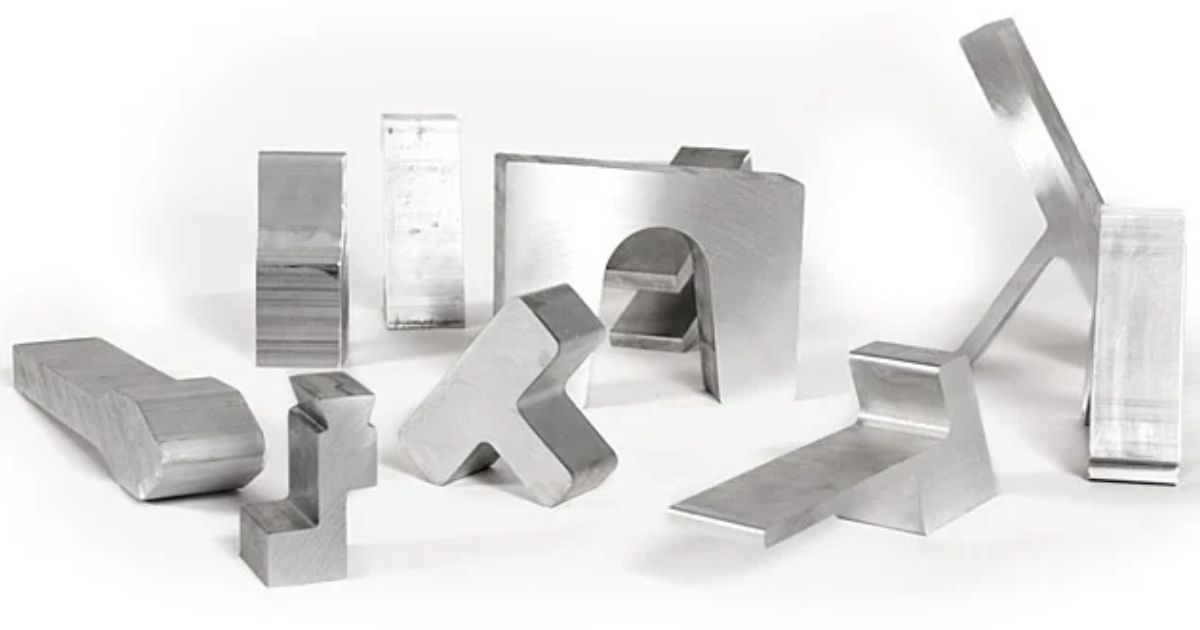
- Manufacturing capability determines whether design intent becomes production reality. Producing hard alloy aluminum extrusions consistently requires specialized presses, process control, and extensive metallurgical expertise.
Choosing among 7000-series aluminum alloys for aerospace and defense programs comes down to a trade-off that data sheet strength numbers do not show. 7075 in the T6 temper delivers peak strength but is more prone to stress corrosion cracking. 7050 holds its properties through thicker sections. Specify the wrong alloy or temper and you inherit a cracking risk, a shorter fatigue life, or a supplier who cannot hold the profile. This guide compares 7075 and 7050 alloys, explains how temper changes the result, and gives you the supplier questions to settle before the drawing is released.
Why 7000-Series Alloys Dominate Aerospace and Defense
7000-series aluminum alloys carry primary structural loads in aircraft, launch systems, and defense vehicles because they offer among the highest strength-to-weight ratios available in aluminum. Zinc is the main alloying element, with magnesium and, in grades such as 7075 and 7050, copper. Aging precipitates fine strengthening phases that give 7075-T6 a specific strength (strength per unit of density) that rivals much heavier structural steels. The trade-off is lower corrosion resistance and a harder extrusion process than 6000-series alloys.
Today, they are widely specified for:
- Aircraft structural members
- Wing spars
- Fuselage components
- Landing gear support structures
- Missile systems
- Space launch hardware
- Defense vehicle structures
- Naval aviation structures
- High-performance transportation equipment
Where a 6061-T6 extrusion yields at 35 ksi, a 7075-T6 extrusion yields at 70 ksi or more (ASTM B221). That gap is why hard alloy aluminum extrusion takes over where weight and structural margin both matter.
According to the Aluminum Association’s aluminum alloy reference, 7000-series alloys represent the highest-strength family of commercially available wrought aluminum alloys while offering an excellent strength-to-weight ratio.
The Aluminum Association’s alloy guide describes the 7xxx series as zinc-based, heat-treatable alloys with extremely high strength that are used throughout the aircraft industry.
7075 vs 7050 Aluminum: Comparing the Leading 7000-Series Aerospace Alloys
Mechanical properties vary considerably across the family. This table compares 7075 and 7050 on the criteria that drive most specifications.
| Property | 7075 | 7050 |
|---|---|---|
| Strength | High in T6; lower in T73 | High; holds up in thick sections |
| Stress corrosion resistance | Lowest in T6; much better in T73 | Strong in T73 and T76 type tempers |
| Fracture toughness | Moderate | Higher than 7075 |
| Thick sections | Properties fall as section grows | Better hardenability, more uniform properties |
| Extrusion difficulty | Moderate | Moderate to high |
| Typical use | Frames, bulkheads, tooling, precision structure | Thick bulkheads, frames, stringers |
7075 Aluminum Extrusion
7075 combines high tensile strength with good machinability, which is why it has remained an aerospace standard for decades.
Typical applications include:
- Aircraft frames
- Bulkheads
- Wing components
- Defense structures
- Tooling
- Precision structural members
7075 delivers exceptional tensile strength and machinability. As a result, it has remained an aerospace standard for decades.
However, 7075 in the T6 temper is more susceptible to stress corrosion cracking, especially in the short transverse direction of thick sections. Many aerospace programs therefore specify 7075-T73 extrusion, supplied as T73511 after stretch stress relief. It gives up roughly 10 to 15 percent of yield strength in exchange for much better stress corrosion and exfoliation resistance. For components with long service lives or harsh environments, that trade is usually worth making.
7050 Aluminum Aerospace Applications
While 7075 receives the most attention, 7050 aluminum aerospace applications have grown substantially over the past several decades.
Compared to 7075, 7050 generally provides:
- Better fracture toughness
- Improved resistance to stress corrosion cracking
- Better exfoliation corrosion resistance in over-aged tempers such as T74 and T76
- Lower quench sensitivity, so properties stay more uniform in thick sections
These characteristics make 7050 especially attractive for:
- Wing stringers and spar caps
- Bulkheads
- Fuselage frames and longerons
- Thick aerospace components
- Thick-section structural extrusions
For extrusions, 7050 is commonly supplied in tempers such as T73511 and T76511.
Engineers working with heavily loaded aircraft structures frequently evaluate 7075 vs 7050 aluminum because each alloy excels under different loading conditions.
Although 7075 often provides higher ultimate strength, 7050 may offer superior long-term durability in demanding service environments.
Aluminum Extrusion Alloy Selection Guide: Which Properties Drive the Choice
Strength alone rarely determines the best alloy. Instead, aerospace engineers typically evaluate multiple performance criteria simultaneously.
Some of the most important criteria in an aerospace aluminum alloy properties comparison fall into two groups.
- Mechanical:
- yield strength
- ultimate tensile strength
- fatigue resistance
- fracture toughness
- stress corrosion resistance
- Manufacturing:
- Machinability
- heat treatment response
- dimensional stability
- availability in the required profile sizes
Selecting an aluminum alloy for defense applications often involves balancing these characteristics against manufacturing constraints, certification requirements, lifecycle expectations, and procurement timelines.
Use the comparison table above as the starting point for your own aluminum extrusion alloy selection guide, then confirm each property against data for your specific temper and section thickness.
The Importance of Temper Selection
Alloy selection represents only half of the engineering decision. Temper selection can dramatically influence mechanical performance.
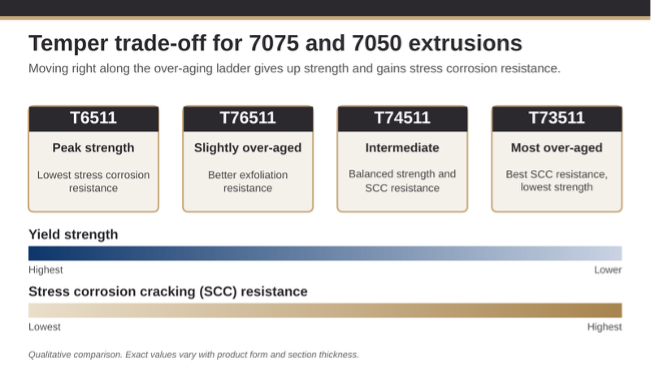
For 7075 and 7050 extrusions, the common tempers sit on a strength versus corrosion trade-off:
- T6511: peak strength, lowest stress corrosion resistance
- T76511: slightly over-aged, better exfoliation resistance, small strength loss
- T74511: intermediate balance of strength and stress corrosion resistance
- T73511: most over-aged, best stress corrosion resistance, lowest strength of the group
The “511” suffix means stress relieved by stretching, which reduces residual stress and later machining distortion.
A 7075-T73 extrusion remains one of the most common aerospace specifications because it balances high strength with improved environmental durability.
Heat treatment must also follow recognized standards to deliver repeatable properties. SAE AMS 2770 governs heat treatment of wrought aluminum alloy parts, and SAE AMS 2772 covers aluminum alloy raw materials such as extruded stock. Confirm which applies to your supply chain and ask whether the supplier’s heat treat process holds NADCAP accreditation.
Designing for Extrusion Manufacturability
Even the best alloy selection cannot compensate for poor extrusion design.
Wall thickness variation, corner radii, profile symmetry, tongue ratios, and bearing design all influence extrusion quality and dimensional consistency. Early collaboration between design engineers and extrusion specialists can reduce redesigns while improving manufacturability.
Many complex aerospace profiles also benefit from integrating multiple features into a single extrusion rather than assembling several machined components later. This approach can reduce weight, decrease machining requirements, improve structural efficiency, and simplify assembly.
Manufacturing Hard Alloy Aluminum Extrusions Is a Specialized Process
Not every extrusion supplier is equipped to produce high-strength 7000-series alloys consistently. Compared to softer aluminum grades, these materials require significantly higher extrusion forces, tighter temperature control, and carefully managed heat treatment throughout production.
Billet chemistry and homogenization are set before the billet reaches the press. Die design, press capacity, and quench then determine the final mechanical properties and dimensional accuracy. Small process variations can change grain structure, surface quality, and overall performance.
For aerospace and defense programs, consistency matters just as much as strength. A supplier’s ability to repeat results across production runs is often evaluated alongside mechanical properties and certifications.
Press Capacity Expands Design Possibilities
As aerospace structures become larger and more complex, extrusion size has become another important consideration.
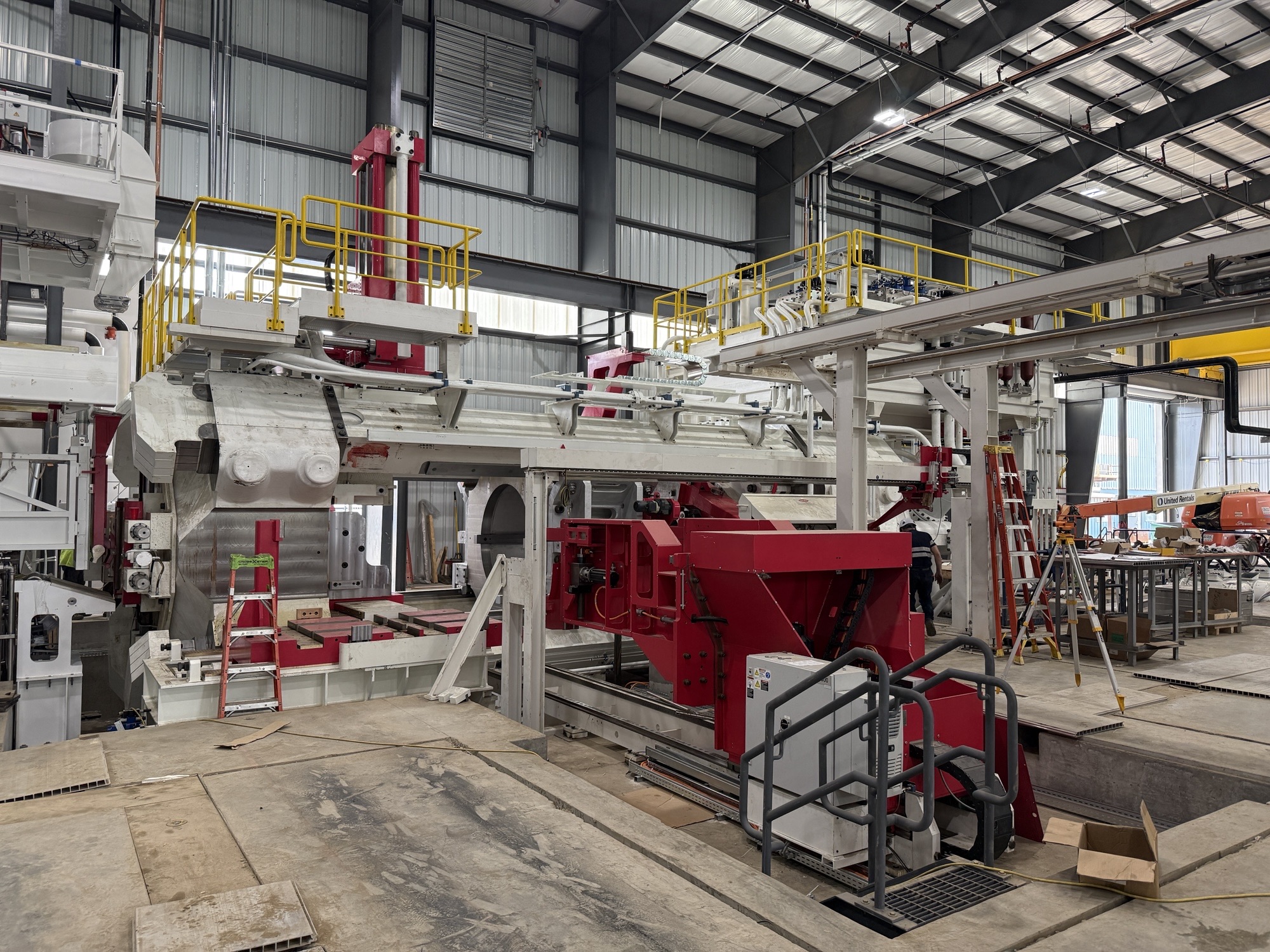
Press tonnage and container size together set the largest profile you can extrude in a hard alloy. Because 7000-series flow stress is higher than 6000-series, a profile that is routine in 6063 can exceed the limits of a smaller press when extruded in 7075 or 7050. Larger presses let engineers specify bigger, more integrated profiles that replace several fabricated or welded parts, which reduces assembly time and removes potential failure points.
When a design calls for oversized hard alloy profiles, confirm the supplier’s press tonnage, container size, and maximum profile envelope in your alloy before you commit to the layout. Only a limited number of North American presses can extrude large 7000-series profiles, so check large aluminum extrusion press capacity early.
How to Evaluate a 7000-Series Aluminum Extrusion Supplier
Selecting the right alloy is only part of a successful program. The supplier’s technical capabilities often determine whether that alloy performs as intended throughout production.
When evaluating an extrusion partner for high-strength aerospace applications, engineers should consider questions such as:
- Does the supplier regularly produce hard alloy aluminum extrusions?
- Can they manufacture large, complex profiles in-house?
- What heat treatment and quenching capabilities are available?
- How is dimensional consistency maintained across production runs?
- Are machining, finishing, and fabrication performed internally?
- Can engineering teams collaborate during profile development?
- Does the supplier have experience supporting aerospace and defense qualification programs?
- Which quality certifications does the supplier hold (for example AS9100D), and does the heat treat scope carry NADCAP accreditation?
- Does every shipment include a certified mill test report with heat number, alloy, temper, and mechanical test results?
- Where is the billet cast, and can the supplier document origin back to the melt?
The answers often reveal more about long-term program success than a data sheet does. Suppliers with vertically integrated operations (billet casting, extrusion, machining, friction stir welding, and finishing) give you fewer handoffs and a single quality record. For the full checklist, see the supplier qualification guide.
Check Defense Sourcing Requirements Before You Specify
Aluminum is not a specialty metal under DFARS 252.225-7009, which covers certain steel, nickel, cobalt, titanium, and zirconium alloys. That does not remove sourcing questions from a 7000-series program. Primes flow down domestic content, country of origin, and traceability requirements to every tier, and Executive Order 14415 directs new supply chain mapping rules that reach raw material origin. Ask early where your billet is cast.
Understanding these requirements early in design can help avoid procurement delays and qualification issues later. For more on how current rules apply to aluminum, see NDAA Section 836 and aluminum extrusion sourcing and the EO 14415 defense supply chain aluminum sourcing explainer.
Additional information regarding specialty metals requirements is available through the DFARS 252.225-7009.
Choosing 7000-Series Aluminum Alloys for Aerospace and Defense: The Bottom Line
Choosing among 7000-series aluminum alloys for aerospace and defense programs takes more than comparing tensile strength. Alloy chemistry, temper, extrusion process control, sourcing documentation, and supplier capability all shape how the finished part performs. Evaluate them together, and start the supplier conversation during design, not after the drawing is released. You will cut revision cycles and qualification surprises.
FAQ – 7000-Series Aluminum Alloys
Providing the profile drawing, alloy and temper requirements, dimensional tolerances, expected production volumes, machining needs, certification requirements, and end-use application helps manufacturers evaluate feasibility and provide more accurate recommendations early in the design process.
Conventional fusion welding is generally avoided on these alloys because of hot cracking and strength loss in the heat-affected zone. Friction stir welding, a solid-state process that does not melt the metal, is often evaluated instead, as are mechanical fasteners. Joint strength and post-weld heat treatment must be qualified for the temper in use.
Not usually. 7075 and 7050 machine well, with good chip control and finish. They do wear tools faster than 6061, and residual stress can distort thin-walled parts after heavy material removal. Specifying a stress-relieved temper such as T73511 (stretched, then aged) reduces that distortion.
Both are high-strength aluminum-zinc alloys, but 7050 was developed to address 7075’s stress corrosion cracking sensitivity in thick sections. 7050 has better hardenability, so properties stay more uniform through the cross-section. 7075 remains widely used for thinner sections where SCC risk is lower.
7075 and 7050 are the most widely specified. 7075 is the general purpose choice for frames, bulkheads, and precision structure. 7050 is preferred for thick sections where uniform properties and stress corrosion resistance matter most.
Specify the right alloy with confidence. Taber Extrusions produces hard alloy aluminum extrusions at its Russellville, Arkansas facility, in profiles from 4.5 to 50 pounds per foot. Our 10,000 ton press is the only one in North America, and our 20-inch and rectangular containers produce the larger profiles in that range. If your program needs 7075 or 7050 in large or complex cross sections, request a quote or talk with our engineering team about alloy, temper, and profile before the drawing is released. Explore hard alloy aluminum extrusions for aerospace.