
When Medical Meets Military Needs, Microextrusions Matter
Key Takeaways:
- Miniaturization and mobility demand uncompromising performance. Medical and defense applications require ultra-precise, lightweight components that can withstand extreme conditions without sacrificing reliability.
- Microextrusions solve the strength-to-size challenge. Precision profiles made from defense-grade aluminum and high-strength alloys deliver the rigidity, durability, and tight tolerances needed in mission-critical environments.
- Taber delivers compliant, high precision microextrusion solutions. With decades of experience and full vertical integration, Taber supports both sectors with traceable materials, strict tolerances, and MIL-SPEC and medical-grade compliance.
Microextrusions sit at the intersection of medical and military innovation, as the demands of battlefield medicine are often used to define the design parameters of advanced medical devices. Consequently, precision tubing and complex profiles are required to meet strict weight-reduction goals and micron-level tolerances. In both operating rooms and forward aid stations, reliability is treated as the primary specification. As a result, defense-grade materials and military aluminum are used to ensure structural integrity and consistent performance. This article, therefore, examines how precision extrusions and high-strength alloys support applications ranging from field surgery kits to ruggedized sensors in harsh operating environments.
Bridging Medical and Military Requirements
Microextrusions are used to meet simultaneous demands for dimensional reduction and structural rigidity as strict tolerances are enforced in both medical and military environments. In addition to facilitating miniaturization, components must be engineered to withstand thermal cycling, vibration, and corrosive exposure. As mobility becomes increasingly critical in modern field operations, lighter and more compact configurations are required without a loss in durability.
Moreover, Department of Defense directives prioritize lightweight, high-performance materials to reduce personnel burden and increase system reliability. For this reason, military aluminum is selected for its superior strength-to-weight ratio, and precision extrusions are widely adopted in weapon systems, portable medical kits, and sensor housings.
Within medical manufacturing, microextrusions are utilized as essential structural elements in endoscopic instruments and heat-exchange systems. While polymers are typically used for flexible internal tubing, aluminum microextrusions are implemented to provide rigid, lightweight frameworks for handheld surgical tools. Notably, research published by the National Institutes of Health indicates growing demand for smaller interventional tools, which in turn requires processes capable of producing thin walls without compromising tensile strength.
Finally, defense-grade materials once limited to combat applications are increasingly incorporated into civilian healthcare systems. Ruggedized sensor housings are being adapted for emergency response equipment, enabled by microextrusion processes that support tighter radii and consistent tolerances at scale, thereby matching the durability expected of military hardware.
Microextrusions in Battlefield Medicine and Field Surgery
Battlefield medicine is governed by mobility, as medical kits are required to remain compact, transportable, and resilient under significant logistical strain. In alignment with Department of Defense priorities, portability and modular construction are emphasized for dispersed operations; therefore, microextrusions are relied upon to meet these specifications.
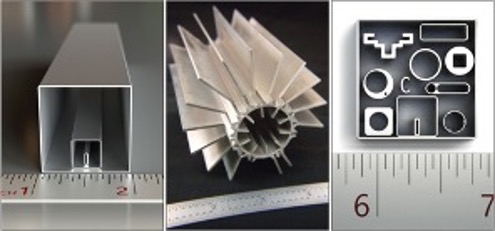
Through microextrusion processes, precision tubing and profiles are produced to maintain the structural integrity of fluid pumps, medication manifolds, and compact sterilization units. Simultaneously, aluminum micro-profiles are used to frame diagnostic enclosures and reinforce handheld medical tools without increasing payload. Beyond this, these profiles are incorporated into field robotics, UAV-mounted sensors, and point-of-care diagnostic units, allowing effective triage in austere environments.
In evacuation equipment design, microextruded components are applied to enhance portability and deployment speed. By means of thinner structural elements with higher stiffness-to-weight ratios, litter frames, diagnostic docks, and stabilization tools are made lighter and faster to deploy.
According to battlefield trauma studies, dependable fluid management systems are critical to survivability in forward care stations. Microextruded aluminum components are implemented to reduce system footprints while maintaining durability. As techniques in field surgery continue to advance, greater demand is placed on ultra-thin, rigid structural tubing for portable medical equipment.
Cross-Sector Innovation: Reciprocal Engineering Advances
Technology transfer moves in both directions between the medical and defense sectors. First, strict tolerance requirements in medical device manufacturing push defense suppliers to refine their extrusion capabilities. Conversely, the ruggedness demanded by military hardware directly shapes the design standards of hospital-grade equipment. As a result, performance expectations continue to rise across both industries.
Prominent examples of this cross-sector application can be seen in:
- Ruggedized sensors originally developed for battlefield diagnostics now used in high-volume civilian emergency rooms
- Field surgery kits built with military aluminum alloys first specified for aerospace applications to reduce weight
- Defense R&D programs adopting medical micro-tubing flow-control standards for precision fluid delivery systems
- Portable imaging devices designed around extruded framing architectures modeled after field sensor housings
Federal initiatives further accelerate this integration by strengthening materials supply chains and advancing lightweight structural systems in defense manufacturing. In turn, the medical sector benefits from improved access to reliable, traceable, high-precision defense-grade materials.
At the same time, sustainability mandates continue to align both industries. Enhanced extrusion efficiency reduces scrap, lowers energy use, and decreases long-term costs. Ultimately, medical OEMs minimize material waste while defense programs gain logistical efficiency and extended equipment lifecycles.
Why Taber Extrusions Supports Both Sectors
Taber Extrusions has decades of manufacturing experience, delivering ultra-precise aluminum extrusions and micro-aluminum extrusions for high-stakes applications. This dual experience supports engineers who require strict geometric tolerances, supply chain stability, and absolute material traceability.
For programs requiring microextrusion technology that can withstand extreme operational stress, Taber offers full vertical integration. In fact, the engineering team actively navigates the complex compliance landscapes of regulated medical environments and military specifications (MIL-SPEC), ensuring they incorporate these standards into their process.
Taber defines reliability as a quantifiable manufacturing metric. For detailed specifications regarding extrusion sizes, alloy options, and fabrication tolerances, review their full capability guide or contact an engineer today to discuss program requirements.
Ready to reduce size without sacrificing strength? Request a custom microextrusion quote below to get started with Taber!