21 12, 2020

Taber Extrusions: Our Friction Stir-Welding Timeline

2020-12-16T04:23:04+00:00December 21st, 2020|

: Infographic that illustrates Taber’s friction stir-welding timeline: 1. March 2019 2. April 2019 3. July 2020 – ending with a CTA that reads, “Learn more about friction stir-welding capabilities like you’ve never seen HERE!’’


Full-service provider of aluminum extrusions, Taber Extrusions, has completed the addition of in-house FSW capabilities, making them a vertically integrated supplier of FSW panels and assemblies never seen before in North America.

Friction Stir-Welding Capabilities Like You’ve Never Seen

Adding to their legacy of innovation, Taber’s new FSW capabilities include simultaneous two side welding, double wall hollow extrusions up to 6.25 inches tall, 32 inches wide, and accepting lengths up to 65 feet long. Taber’s friction stir-welding production cell is capable of creating panel assemblies 200 inches wide by 65 feet long, with integrated pre-joining profile trimming. With profile widths up to 31 inches, lengths up to 65 feet, and an ability to weld up to 3/4 of an inch in a single pass, Taber has an operational envelope that is unmatched within the industry.

Friction stir-welding is commonly used in the rail, automotive, marine & shipbuilding industries, military & defense, commercial & industrial construction, infrastructure, and aviation & aerospace sectors.


TABER EXTRUSIONS HISTORY AND RECENT GROWTH

Founded in 1973, Taber Extrusions originally pioneered a process for extruding rectangular billet which enables the company to extrude solid profiles up to 31 inches wide or hollows up to 29 inches. Taber expanded with the purchase of an extrusion facility in Gulfport, MS in 1995 which houses a cast house and two additional presses, and multiple expansions of value added fabrication services. Taber continues to extrude billet in a wide range of alloys and sizes, including 7″ billet molds, and has diversified its markets beyond military since its inception to include aerospace, automotive, marine, infrastructure, and sporting goods, among many others. For these markets, the company supplies extruded products in a variety of soft and hard alloys. In 2018, Taber added ultra-precision® extrusions to their capabilities allowing them to further serve customers in electronics, computer, and medical industries. Taber recently announced yet another exciting launch into friction stir-welding, positioning them as a vertically integrated supplier of FSW panels and assemblies never seen before in North America.

Thank you for your continued support of Taber Extrusions, LLC. If you have any questions please visit taberextrusions.com or contact one of Taber’s Regional Sales Managers.

Follow Taber Extrusions

LINKEDIN: https://www.linkedin.com/company/taberextrusions/

FACEBOOK: https://www.facebook.com/taberextrusions/

TWITTER: https://twitter.com/taberextrusions

16 12, 2020

Microextrusions In The Consumer Electronics Sector

2024-01-12T04:12:17+00:00December 16th, 2020|

A sleek, modern wooden desk with various consumer electronics neatly organized across the top. Items include a laptop, iPad, two cell phones, small stereo speakers, and headphones.


A SPECIAL NOTE ON VIRUSES AND BACTERIA IN RESPECT TO ALUMINUM SURFACES:

At this time of extreme health concern, specifiers must carefully consider how material choices may impact the spread of viruses, bacteria, and infectious diseases in healthcare facilities and other public spaces.

While much about the coronavirus is still under investigation, research has demonstrated significant differences in the longevity of viruses on various surfaces, and there are a variety of treatments that appear to further reduce the growth and survival of viruses and bacteria, enhancing the surface’s ability to destroy pathogens.

A major research study published in the Journal of Hospital Infection tested human coronavirus strains for longevity on various material surfaces and found that the virus lasted only two to eight hours on aluminum, but days on many other materials.

We encourage you to access the full white paper on this topic which can be found at AEC.org.

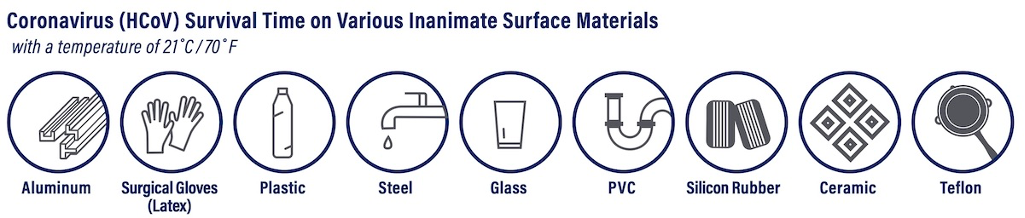
An infographic consisting of icons depicting various surface materials (aluminum, surgical gloves, plastic, steel, glass, PVC, silicon rubber, ceramic, and Teflon) with the headline, “Coronavirus (HCoV) Survival Time on Various Inanimate Surface Materials”

Are you familiar with Moore’s Law?

Gordon Moore, the co-founder of Intel, made a striking observation: the number of transistors on a dense integrated circuit doubles about every two years. In essence, as computer hardware grows more complex, it shrinks in size.

Consider the evolution you’ve witnessed. The first bulky smartphone you bought in 2007 pales in comparison to the sleek, powerful device you carry today. The latest models are slimmer, yet larger and far more powerful in terms of energy-per-gram than their predecessors.

Tech companies are always pushing for smaller, micro-sized innovations, and industrial OEMs must evolve with new technologies to compete.

Microextrusions represent such an innovation, offering features, tolerances, and surface finishes once thought unachievable. This advancement gives design engineers the freedom to explore new component designs that improve functionality and performance over traditional extruded parts.

We’ll now examine several consumer electronics components that utilize precision aluminum extrusions in their designs.

CPU HEAT SINKS

The CPU, or central processing unit, serves as the computer’s brain, executing arithmetic, logic, and I/O operations from other computer components’ instructions. The intense activity can cause CPUs to overheat, necessitating a heat sink for heat dissipation and cooling.

Microextrusion technology enables the creation of even more efficient heat sinks. Maintaining an optimal CPU temperature is crucial for sustained performance.

MOTHERBOARDS

Motherboards utilize microextrusions for ethernet and USB port housings, as well as for DVI, HDMI, and audio in/out ports.

This technology is vital for the CPU socket too, often incorporating a latch to secure the CPU and connect it to the motherboard.

GRAPHICS PROCESSING UNITS

High-end graphics cards, like NVIDIA’s Titan V, feature an aluminum casing that not only protects the GPU’s internals but also adds an aesthetic appeal.

HARD DRIVE BAYS

Modern hard drives come with mounting brackets and fit into an extruded aluminum bay within the computer case. This secures them during operation, which is crucial as hard drives are sensitive to physical shocks.

: A close-up view of a computer circuit board of some kind, with various ports and exposed wires.

LED PROFILE BAYS

Microextruded profile bays serve as housings for LED lights, utilizing ultra-fine materials and plastics that not only allow the LEDs to emit light effectively but also offer protection from environmental elements.

EXTRUDED ENCLOSURES

Aluminum, a non-sparking, melt-resistant, and rust-proof metal, is ideal for enclosures, especially for consumer electronics that contain sensitive magnets. Its versatility allows customization to meet any product’s specific requirements.

About Taber Extrusions

Established in 1973, Taber Extrusions has been at the forefront of extruding rectangular billet, allowing for the production of large solid profiles up to 31 inches wide and hollows up to 29 inches. With the acquisition of a Gulfport, MS extrusion facility in 1995, Taber not only broadened its capabilities with a cutting-edge cast house and two additional presses but also enhanced its micro-extrusion and fabrication services.

Today, Taber Extrusions has completed the addition of in-house friction stir-welding capabilities, and carries on their offering of extruded aluminum components, value-added machining services and raw material supply to the North American market – making them a vertically integrated supplier of FSW panels and assemblies never before seen in North America.

Follow Taber Extrusions

LINKEDIN: https://www.linkedin.com/company/8843183/

FACEBOOK: https://www.facebook.com/taberextrusions/

TWITTER: https://twitter.com/taberextrusions
Interested in becoming a part of the Taber Team?

Submit your resume to careers@taberextrusions.com.

4 12, 2020

Process, Benefits, and Examples of Medical Microextrusions

2020-12-04T01:28:40+00:00December 4th, 2020|

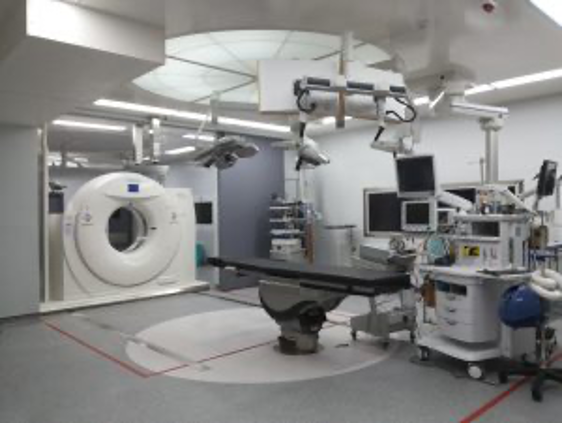
A brightly lit medical office containing an MRI machine and various other high tech medical testing equipment.

A SPECIAL NOTE ON VIRUSES AND BACTERIA IN RESPECT TO ALUMINUM SURFACES:


At this time of extreme health concern, specifiers must carefully consider how material choices may impact the spread of viruses, bacteria and infectious diseases in healthcare facilities and other public spaces.

While much about the coronavirus is still under investigation, research has demonstrated significant differences in the longevity of viruses on various surfaces, and there are a variety of treatments that appear to further reduce the growth and survival of viruses and bacteria, enhancing the surface’s ability to destroy pathogens.

A major research study published in the Journal of Hospital Infection tested human coronavirus strains for longevity on various material surfaces and found that the virus lasted only two to eight hours on aluminum, but days on many other materials.

We encourage you to access the full white paper on this topic which can be found at AEC.org.

An infographic consisting of icons depicting various surface material (aluminum, surgical gloves, plastic, steel, glass, PVC, silicon rubber, ceramic, and Teflon.) with the headline, “Coronavirus (HCoV)) Survival Time on Various Inanimate Materials”

Medical Microextrusions: Process, Benefits, and Examples

Advancements in medical microextrusions technology in recent years have allowed manufacturers to create high quality products for the world of medical OEMs. With a range of dimensions that can reach as small as 0.024 in., OD with up to 6 lumens, and an ID range that can reach 0.003, it’s no surprise that many OEMs are turning to companies like Taber Extrusions that can provide products within these parameters. (Source: medicaldesignbriefs.com)

In fact, micro-sized medical components are quickly becoming crucial to modern hospital safety and cost-efficiency. Whether it be for micro-tubing or micro sized components, the microextrusion process provides a number of benefits to engineers, OEMs, and patients.

In the quest to create higher quality medical devices, companies are looking to enhance existing products (including catheters and precise flow restrictors) through miniaturization, while ultimately reducing the costs of production.

Medical products that utilize microextrusion technology overwhelmingly support cardio-and-neurovascular procedures, drug delivery, IV procedures, and other procedures that require work on a micro level.

By minimizing the impact of invasive procedures, the medical industry can reduce complications, make procedures faster and more efficient, and ultimately reduce patient in-time and overall healthcare costs.

Closeup angle of a bundle of medical microextrusions with a blue overlay on the photo.

WHAT’S THE MICROEXTRUSION PROCESS LIKE?

Manufacturing the miniature components used in a medical microextrusion device poses a unique challenge for microextrusion providers. These components cannot be created using conventional extrusion machinery. Instead, they require precise, state-of-the-art equipment that allows for a high degree of precision and control over the process, as well as Engineers and technicians that possess deep knowledge of both the material and the process itself.

However, at its core, the process is similar to that of regular extrusion.

The material is either pushed forward (direct) or pulled through (indirect) a die orifice to create the shape required. Unlike macro-level extrusions, microextrusions are extruded at a very slow rate to maintain the physical properties of materials that are often delicate.

Done properly, microextrusions can create end products that have complex cross sections and preserved chemical properties.

BENEFITS TO OEMs

Lower Time-to-Market

In years previous, OEM’s requests for medical products would require them to re-outfit their existing extrusion machines, which would take more time and far less efficient. With many manufacturers outfitting themselves with microextrusion machinery, the time required to create the product is drastically reduced.

Lower Costs

As stated above, microextrusions can achieve their desired performance at fractions of the cost, due to the lower cost in materials that are used. As the development of the technology continues to improve, so to do the devices that are used in tandem with them. (i.e fibre optic cable, sensors, stints, etc.)

Psychological benefit to patients

A patient’s positive mental state can be a great asset to their recovery. Waning are the days of large, invasive medical devices that can cause patients discomfort. Smaller, less intrusive devices can go a long way. (source: Medical Plastic News)

POTENTIAL APPLICATIONS

  • Infant/pediatric care
  • Heart leads
  • Neurological
  • Vascular Surgery
  • Catheters
  • Radiology
  • Urology
  • Oncology

About Taber Extrusions

Founded in 1973, Taber Extrusions originally pioneered a process for extruding rectangular billet which enables the company to extrude solid profiles up to 31 inches wide or hollows up to 29 inches. Taber expanded with the purchase of an extrusion facility in Gulfport, MS., in 1995 which houses a new state of the art cast house and two additional presses, micro-extrusion capabilities, and the fabrication area has been expanded multiple times.

Taber continues to extrude billet in a wide range of alloys and sizes, and has diversified its markets beyond military since its inception to include aerospace, automotive, marine, infrastructure, and sporting goods, among many others. For these markets, the company supplies cast and extruded products in a variety of soft and hard alloys.

Today, Taber Extrusions has completed the addition of in-house Friction Stir Welding capabilities, and carries on their offering of extruded aluminum components, value-added machining services and raw material supply to the North American market – making them a vertically integrated supplier of FSW panels and assemblies never before seen in North America.

Follow Taber Extrusions

LINKEDIN: https://www.linkedin.com/company/8843183/

FACEBOOK: https://www.facebook.com/taberextrusions/

TWITTER: https://twitter.com/taberextrusions

Interested in becoming a part of the Taber Team?  Submit your resume to careers@taberextrusions.com.

Become a customer today! Visit us or request a quote: https://taberextrusions.com or call us at (888) 985-5319.

20 07, 2020

Taber Extrusions Friction Stir Welding Capabilities Further Serving Marine, Defense, and Infrastructure Sectors

2020-08-31T21:05:16+00:00July 20th, 2020|

Full-service provider of aluminum extrusions, Taber Extrusions, has completed the addition of in-house FSW capabilities, making them a vertically integrated supplier of FSW panels and assemblies never before seen in North America.

Full-service provider of aluminum extrusions, Taber Extrusions, has completed the addition of in-house FSW capabilities, making them a vertically integrated supplier of FSW panels and assemblies never before seen in North America. “This was an obvious next-step for Taber,” said Jason Weber, V.P. of Sales and Marketing, in a recent article by Light Metal Age Magazine. “The company was founded in 1973, and never stopped diversifying, adding new capabilities, and technologies. We are known for aluminum extrusions, fabrication, billet casting, ultra-precision extrusions. Friction stir welding was going to happen eventually.”

Taber Extrusions, located in Russellville, AR. and Gulfport, MS., is a highly regarded provider of aluminum extrusions to a wide variety of industries including aerospace, infrastructure, transportation, defense, and thermal management. ISO 9001 and AS 9100 certified, Taber’s present and future customers can expect to see increased supply opportunities with the expanded set of extrusion solutions, programs and services.

Friction Stir-Welding Capabilities Like You’ve Never Seen

Adding to their legacy of innovation, Taber’s new FSW capabilities include simultaneous two side welding, double wall hollow extrusions up to 6.25 inches tall, 32 inches wide, accepts lengths up to 65 feet long. Taber’s friction stir welding production cell is capable of creating panel assemblies 200 inches wide by 65 feet long, with integrated pre-joining profile trimming. With profile widths up to 31 inches, lengths up to 65 feet, and ability to weld up to 3/4 of an inch in a single pass, Taber has an operational envelope that is unmatched within the industry.

Friction Stir Welding is commonly used in the rail, automotive, marine & shipbuilding industries, military & defense, commercial & industrial construction, infrastructure, aviation & aerospace.

Founded in 1973, Taber Extrusions originally pioneered a process for extruding rectangular billet which enables the company to extrude solid profiles up to 31 inches wide or hollows up to 29 inches. Taber expanded with the purchase of an extrusion facility in Gulfport, MS., in 1995 which houses a new state of the art cast house and two additional presses, micro-extrusion capabilities, and the fabrication area has been expanded multiple times. Taber continues to extrude billet in a wide range of alloys and sizes, and has diversified its markets beyond military since its inception to include aerospace, automotive, marine, infrastructure, and sporting goods, among many others. For these markets, the company supplies cast and extruded products in a variety of soft and hard alloys. Today, Taber Extrusions is proud of its friction stir welding capabilities, and full offering of extruded aluminum components, value-added machining services and raw material supply to the North American market.

Thank you for your continued support of Taber Extrusions, LLC. If you have any questions please visit taberextrusions.com or contact one of our Regional Sales Representatives.

Follow Taber Extrusions:
LINKEDIN: https://www.linkedin.com/company/taberextrusions/
FACEBOOK: https://www.facebook.com/taberextrusions/
TWITTER: https://twitter.com/taberextrusions
11 04, 2020

The Lifecycle of an Aluminum Billet in The Extrusion Process

2020-05-11T21:45:55+00:00April 11th, 2020|

infographic that takes us through the lifecycle of an aluminum billet in the extrusion process: 1. The aluminum alloy chemistry 2. Billet casting 3. Aluminum extrusion process 4.Delivery 5.End Product 6. Recycling! – Ending with a CTA that reads, “Are you located in North America? Call or visit our website to see if you qualify for Taber’s “Billets Straight To You” inventory! 7”, 9”, and 11” billet delivered in a week!”

TABER EXTRUSIONS HISTORY AND RECENT GROWTH

Founded in 1973, Taber Extrusions originally pioneered a process for extruding rectangular billet which enables the company to extrude solid profiles up to 31 inches wide or hollows up to 29 inches. Taber expanded with the purchase of an extrusion facility in Gulfport, MS., in 1995 which houses a cast house and two additional presses, and multiple expansions of value added fabrication services. Taber continues to extrude billet in a wide range of alloys and sizes, including 7″billet molds, and has diversified its markets beyond military since its inception to include aerospace, automotive, marine, infrastructure, and sporting goods, among many others. For these markets, the company supplies extruded products in a variety of soft and hard alloys. In 2018, Taber added ultra-precision® extrusions to their capabilities allowing them to further serve customers in electronics, computer, and medical industries. Taber recently announced yet another exciting launch into friction stir welding, positioning them as a vertically integrated supplier of FSW panels and assemblies never before seen in North America.

Thank you for your continued support of Taber Extrusions, LLC. If you have any questions please visit taberextrusions.com or contact one of Taber’s Regional Sales Managers.

Follow Taber Extrusions

LINKEDIN: https://www.linkedin.com/company/taberextrusions/

FACEBOOK: https://www.facebook.com/taberextrusions/

TWITTER: https://twitter.com/taberextrusions

11 03, 2020

Taber Aluminum Alloys: Straight to You!

2020-05-12T17:58:44+00:00March 11th, 2020|

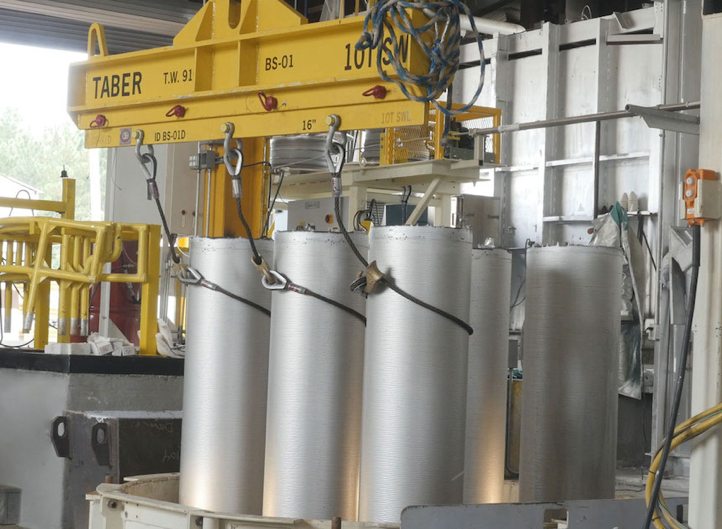
Aluminum billets being casted at Taber Extrusions’ upgraded aluminum casthouse in Gulfport, Mississippi.

Here at Taber, we’ve listened to market demands by updating our Gulfport, MS. casthouse, and we are now proud to offer top quality aluminum alloys made in the U.S.A. delivered to you within a short lead time.

From Aluminum Alloy to End Use

Aluminum billets (also referred to as “logs” or “ingots”) are not of practical use until they have been formed into more functional shapes and sizes. While they have already been put in the furnace, they still require a series of shaping and molding procedures such as hot and cold working, milling, and cutting.

Aluminum billets are considered fresh and raw, and they must undergo a series of manufacturing processes before they can be used for various purposes. Billets are made by means of freezing molten liquid and are later exposed to extremely low temperatures in order to allow the metal to take shape and solidify in chemical structure. The temperature manipulates the metal’s physical properties and tones its strength and durability. The subsequent processes provide the metal’s curved mold design, so it can fit inside the allotted spaces provided by other machines, which complete finishing procedures.

Taber cast house favoring a freshly casted stack of 16 billets.


Proper casting is important, as it determines the quality of the product upon going through the final processing stages. These stages influence the billet’s strength and flexibility. The billets undergo a number of tests before they are sold.

Taber’s “Alloys Made in The U.S.A. For Immediate Sale” Chemical Composition Chart

A chemical compound chart for the 6061, 6063, 6005, 6005A, and 6082 alloys.


If you are looking for top quality aluminum alloys made in the U.S.A. delivered to you within a short lead time, look no further than Taber Extrusions.

Taber is proud to announce their “Aluminum Alloys Made in The U.S.A. For Immediate Sale” initiative – featuring short lead times and less than truckload quantities.

General specifications include aluminum alloys 6061 and 6063.* Diameters offered include 7”, 9”, 11” and 16” (actual diameter 15 5/8”) and log lengths of 191” (+.125” -0). Specific chemical composition for alloys can be viewed on Taber’s website. Freight Terms: Freight on Board – Gulfport, Mississippi.

Anticipating a successful aluminum alloy sale, Taber recommends that customers call for availability. “When our casthouse was upgraded in 2017, we were thrilled to be able to offer extrusion logs to our fellow extruders. Now, in 2020 we are excited to add stock and speed to the equation.” says Jason Weber – VP Sales and Marketing at Taber. The Gulfport Casthouse is uniquely situated with port access as well as easy access to industrial scrap. These input factors

coupled with the recently refurbished casting equipment with the LARS® in-line degassing and purification system supplies chemistries and consistencies which rival those of larger producers.

About Taber Extrusions

Taber Extrusions is a full-service partner with an unwavering commitment to consistently meeting and exceeding customer expectations by providing both products and services of the highest quality. This commitment is at the core of Taber’s value-added philosophy.

Unique, customized capabilities are key. Taber’s specialty is the manufacturing of complex and intricate extrusions which competitors consider difficult or even impossible. Taber’s full range of extrusion presses give them unmatched flexibility and profile capabilities. Their value-added philosophy, along with their impressive portfolio of custom capabilities and top-tier customer service is why Taber Extrusions has been a leader in the extrusion industry for over four decades.

Become a customer today! Visit us at https://taberextrusions.com/. You can also contact us/request a quote on our website, or call us at (888) 985-5319.

24 02, 2020

Taber Extrusions Announces “Alloys Straight To You” Initiative

2020-08-31T21:02:02+00:00February 24th, 2020|

Aluminum extrusion leader Taber Extrusions announces aluminum alloys made in the U.S.A. for immediate sale – featuring short lead times and less than truckload quantities.

Taber Extrusions, LLC announces aluminum alloys made in the U.S.A. for immediate sale – featuring short lead times and less than truckload quantities.

General specifications include aluminum alloys 6061 and 6063.* Diameters offered include 7”, 9”, 11” and 16” (actual diameter 15 5/8”) and log lengths of 191” (+.125” -0). Specific chemical composition for alloys can be viewed on Taber’s website. Freight Terms: Freight On Board – Gulfport, Mississippi.

Anticipating a successful aluminum alloy sale, Taber recommends that customers call for availability. “When our casthouse was upgraded in 2017, we were thrilled to be able to offer extrusion logs to our fellow extruders. Now, in 2020 we are excited to add stock and speed to the equation.” says Jason Weber – VP Sales and Marketing at Taber. The Gulfport Casthouse is uniquely situated with port access as well as easy access to industrial scrap. These input factors coupled with the recently refurbished casting equipment with the LARS® in-line degassing and purification system supplies chemistries and consistencies which rival those of larger producers.

TABER EXTRUSIONS HISTORY AND RECENT GROWTH

Founded in 1973, Taber Extrusions originally pioneered a process for extruding rectangular billet which enables the company to extrude solid profiles up to 31 inches wide or hollows up to 29 inches. Taber expanded with the purchase of an extrusion facility in Gulfport, MS., in 1995 which houses a casthouse and two additional presses, and multiple expansions of value added fabrication services. Taber continues to extrude billet in a wide range of alloys and sizes, including 7″billet molds, and has diversified its markets beyond military since its inception to include aerospace, automotive, marine, infrastructure, and sporting goods, among many others. For these markets, the company supplies extruded products in a variety of soft and hard alloys. In 2018, Taber added ultra-precision® extrusions to their capabilities allowing them to further serve customers in electronics, computer, and medical industries. Taber recently announced yet another exciting launch into friction stir welding, positioning them as a vertically integrated supplier of FSW panels and assemblies never before seen in North America.

Thank you for your continued support of Taber Extrusions, LLC. If you have any questions please visit taberextrusions.com or contact one of Taber’s Regional Sales Managers.

*6005, 6005A, 6082 available upon request.

Follow Taber Extrusions

LINKEDIN: https://www.linkedin.com/company/taberextrusions/
FACEBOOK: https://www.facebook.com/taberextrusions/
TWITTER: https://twitter.com/taberextrusions

17 02, 2020

Taber: Advanced Friction Stir Welding Capabilities

2020-02-17T19:42:22+00:00February 17th, 2020|

Something big is happening at Taber: Friction Stir Welding has been added to their already extensive portfolio of capabilities. #TheShapeOfEndlessPossibilitiies #Taber #Aluminum Extrusions #FSW

11 02, 2020

Taber’s Friction Stir Welding Capabilities: Going Vertical

2020-05-11T21:05:07+00:00February 11th, 2020|

Taber’s Friction Stir Welding Capabilities Infographic

Taber is is AS9100, NADCAP, and ABS certified. Founded in 1973, Taber Extrusions originally pioneered a process for extruding rectangular billet which enables the company to extrude solid profiles up to 31 inches wide or hollows up to 29 inches. Taber expanded with the purchase of an extrusion facility in Gulfport, MS., in 1995 which houses a cast house and two additional presses, and multiple expansions of value-added fabrication services. Taber continues to extrude billet in a wide range of alloys and sizes, including 7”billet molds, and has diversified its markets beyond military since its inception to include aerospace, automotive, marine, infrastructure, and sporting goods, among many others. For these markets, the company supplies extruded products in a variety of soft and hard alloys. In 2018, Taber added micro-extrusions to their capabilities allowing them to further serve customers in electronics, computer, and medical industries. Today Taber is proud to announce yet another exciting launch into Friction Stir Welding. To learn more about how we can be of service visit: https://taberextrusions.com/

Follow Taber Extrusions

LINKEDIN: https://www.linkedin.com/company/8843183/

FACEBOOK: https://www.facebook.com/taberextrusions/

TWITTER: https://twitter.com/taberextrusions

1 02, 2020

Aluminum Extrusion Leader Taber Extrusions Looks Ahead

2020-02-01T20:39:14+00:00February 1st, 2020|

“2020” written in shiny, silver-colored metal – with the inverted gold Taber Extrusions logo positioned underneath.

As Taber Extrusions launches into 2020, we thought we’d take a look back at the last several years and the many ways Taber has progressed within the aluminum extrusion industry. Among many changes, Taber added an upgraded casthouse, expanded into micro extrusions; received various awards, began friction stir welding, and brought on a new business director. This has been a very exciting time, and we invite you to learn more about the innovations that are shaping endless possibilities in 2020 and beyond.

Aluminum Casthouse

Not long ago in 2017, Taber upgraded to their aluminum casthouse in Gulfport, MS. which integrates casting, extrusion, and in-house fabrication services. With this upgrade, Taber opened up opportunities in a variety of markets, with the sale of cast billet to outside extruders.  With this casthouse, Taber is targeting aerospace, automotive, and defense industries, all of which utilize aluminum at an accelerated rate. Taber’s new products are suitable for current and future U.S. infrastructure projects, such as the construction and improvement of bridges, decking, flooring, and railing for mass transportation projects.

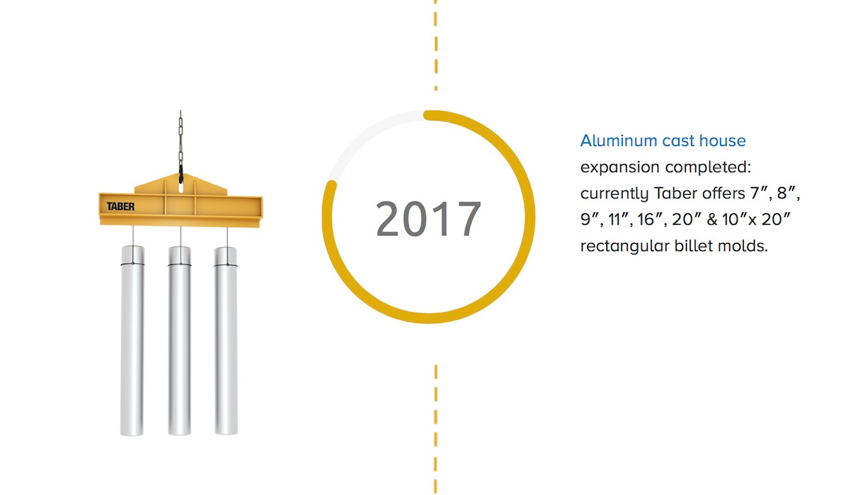
A 3D rendering of a yellow aluminum billet crane suspending 3 freshly casted shiny silver billets. Beside the image it reads: “currently Taber offers 7″, 8″, 9″, 11″, 16″, 20″ & 10″x 20″ rectangular billet molds.”

Partnering with Almex USA, Taber developed a customized solution to meet Taber’s unique requirements and specifications. Almex supplied new equipment, including a casting line with a degassing and melt purification system, billet and slab tooling, automation technology, and a complete homogenizing line, as well as a new cooling water system.

Benefits to Taber’s aluminum casthouse upgrade:

  • Increased Production. The CASTRIGHT II™ casting machine and new billet and slab tooling stations were adapted to fit the circular pit, and the casting tables were modified to have an oval shape with unique headbase configurations. Excel™ and Optima™ billet mold systems were installed for various sized billets. The quantity of billet produced with each cast has been enlarged, allowing increased production per drop.
  • Quality Control. A large part of Taber’s consideration during this upgrade was quality control. Taber now has a level pour (or, hot-top) mold table distribution system and a way to optimize mold lengths for consistent billet quality. Taber’s goal was safety and alloy versatility for high performance and yield, from conventional to the most demanding alloys. For the larger diameter aerospace grade products, Almex installed specialized water wiping technology in order to manufacture difficult to cast materials without the formation of stresses or cracks. With the new casting line, Taber increased monitoring and automation, and now has computer control of all critical casting and degassing parameters. Operators now interact with the system through an integrated SCADA control panel installed on the plant floor in order to monitor the correct mixture of several ingredients that make up the casting recipe. At the end of each cast, the system automatically generates a complete report of the heat number for reference and archival by quality control personnel. With this new system, Taber has not only achieved a greater level of quality control, but process transparency and product traceability.
  • Accuracy and Precision. An internally guided and double acting platen cylinder was installed, which has more loading capacity, guiding accuracy, and precision speed control (needed for hard alloys).
  • Consistency and Strength. The new casting line also includes a LARS® in-line degassing and purification system that refines and cleans the melt prior to casting. The LARS system mixes inert argon gas and a halogen gas into the molten aluminum through Almex’s patented in-situ gas preheating disperser system. This significantly reduces hydrogen and other impurities commonly found in liquid aluminum, including inclusions, nitrides, oxides, and alkali metals and also increases recovery through a minimal amount of dross creation. This high quality of the molten metal is, thus, dependably strong and consistent.
  • Environmentally Friendly. Taber rebuilt and integrated its water management system, which provides increased visibility of the water flow, temperature, quality, and maintenance. Water is discharged in a safe and controlled manner.

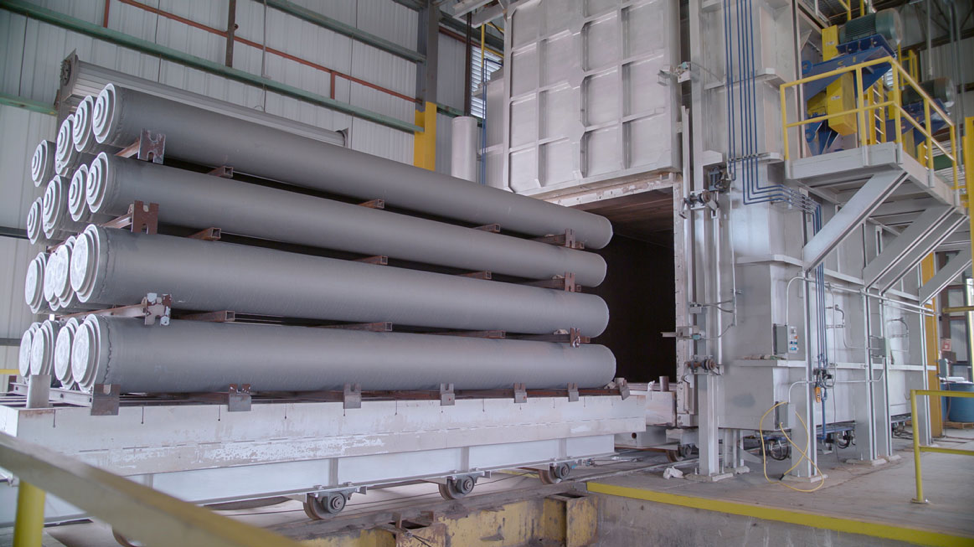
16 fresh aluminum billets atop Taber’s casting table engineered to fit the existing circular casting pit.

Ultra Precision® Extrusions

In 2018, Taber added micro extrusion capabilities into their portfolio. Micro-extrusions are used in a number of industries, such as electronics, aerospace, medical, industrial, and military. The addition of small precision profiles will allow Taber to better serve existing customers and future partners such as – defense contractors, commercial aerospace engineers, and electronics designers.

A 3D rendering of am 8-inch ruler with a variety of micro extrusion shapes fitting elegantly inside roughly a 1-inch white square, and the words “The Shape of Endless Possibilities, Ultra Precision® Extrusions, Taber”

The micro-extrusion manufacturing lines have a production envelope with a circle size of 3 inches or less and a weight per foot of 1 lb. or less. Unlike traditional extrusion presses, these micro-extrusion presses are built in such a way to allow for the production of extrusions with wall thicknesses of 0.010 inches and tolerance capabilities of +/- 0.001 inches. This allows designers and engineers the freedom to engineer profiles that are impossible to extrude through conventional presses.

The addition of  ultra precision® extrusions allows the company to enhance its business to provide a wider range of profile sizes and competencies which blend beautifully with the various sectors already being served by Taber.

2018 NMLP Safety Award

Taber Extrusions took home National Material L.P.’s 2018 Safety Excellence Award for exceptional safety management at their Russellville, Arkansas facility.

Russellville Plant Manager Gavin Butterworth, Taber President Eric Angermeier, and Gulfport Plant Manager Mike Keenan standing with the NMLP Safety Award trophy during the 2018 holiday party.

Taber’s safety management system includes:

  • Perpetual assessment & evaluation of existing safety policies
  • Process & workflow analysis
  • Establishment of safety work procedures
  • Safety training & meetings
  • Safety inspections
  • Maintenance regimens of plants, equipment, and processes
  • Identification of hazards & hazard analysis
  • Facilitation of occupational health programs
  • Emergency preparedness
  • Documentation control & management reviews

2019 Taber Extrusions Recognized by Russellville for Energy Savings Excellence

Taber Extrusions employees stand alongside Entergy and CLEAResult personnel in front of the Taber sign at their Russellville location. They are holding an extra-large check for $31,748 – representing Taber’s energy savings.

Taber Extrusions created a plan to reduce power consumption by implementing energy efficient measures while participating in the Entergy Arkansas Energy Solutions Program assisted by CLEAResult consulting company.

“I couldn’t be happier to assist Arkansas businesses reduce their power consumption by energy efficient measures. Every project that CLEAResult assists a customer with is a positive step in their energy reduction,” says Taylor Dumas, West Regional Account Manager at Entergy Arkansas Energy Solutions Program. “The Taber Extrusions project is one that greatly reduced power consumption, increases machine efficiency, and makes Taber Extrusions a ‘greener’ business by completing this project.”

Taber’s commitment to energy savings still holds strong as they push forward into the future, making environmental accountability part of their company culture.

Friction Stir Welding Technology

In 2019, Taber  installed a new friction stir welding (FSW) line at its Russellville, Arkansas, manufacturing facility. Sometimes described as more of a forging process than actual welding – FSWis a solid-state joining technique used to join metals not easily fused with traditional welding. It is used in the aerospace, rail, automotive, marine, transportation, and other industries that use metals such as aluminum, copper and other metal alloys. The new FSW line that welds large, double-sided thick profiles, uses minimal cycles of the machine, which make it both efficient and precise. FSW also makes possible very high-quality welds with minimal distortion.

The addition of friction stir welding illustrates how Taber has proven itself to be dedicated to the technological advances in the industry, economic development, and job production. The line enables the company to be a vertically integrated supplier of FSW panels and assemblies in North America, with capabilities including aluminum extrusions, fabrication, billet casting, and micro-extrusions.

Already known for their wide range of capabilities, both broad and unique, the mayor of Russellville, Richard Harris, thanked Taber for choosing Russellville as their location, “The fact that you chose to expand and add new technology here is the highest compliment you can give the city and citizens where you live and work. Economic development and job creation is one of our top priorities. We congratulate Taber on this advancement.”

Jeffrey Bladow: Director of New Business Development

Photographic portrait of Jeffrey Bladow, Director of New Business Development, Taber Extrusions

Taber’s rapid growth initiated the presence of Jeffrey Bladow, the company’s recently appointed Director of New Business Development. Hired to help lead business growth and assist in building strategy, Bladow has spent over 25 years in automotive design and manufacturing. He also has experience in structure design, high strength steel applications, and the launch of large capital projects. Like Taber, Bladow is comfortable solving multi-faceted problems. In his management style, Bladow encourages “critical thinking, continuous improvement, and a no-fear approach to growing and entering new markets.”  Taber feels lucky to have Jeffrey Bladow ushering us into a new decade.

At Taber we believe the possibilities are endless.  We believe in the future.

About Taber:

Founded in 1973, Taber Extrusions originally pioneered a process for extruding rectangular billet which enables the company to extrude solid profiles up to 31 inches wide or hollows up to 29 inches. Taber expanded with the purchase of an extrusion facility in Gulfport, MS., in 1995 which houses a cast house and two additional presses, and multiple expansions of value added fabrication services. Taber continues to extrude billet in a wide range of alloys and sizes, including 7″billet molds, and has diversified its markets beyond military since its inception to include aerospace, automotive, marine, infrastructure, and sporting goods, among many others. For these markets, the company supplies extruded products in a variety of soft and hard alloys. In 2018, Taber added ultra-precision extrusions to their capabilities allowing them to further serve customers in electronics, computer, and medical industries. Today Taber is proud to announce yet another exciting launch into friction stir welding. Call us at (888) 984-9866, or request a quote today!

Go to Top