8 03, 2026

How Large Aluminum Extrusions Support Military, Naval, and Government Infrastructure Projects

2026-03-08T23:37:16+00:00March 8th, 2026|

A naval vessel with metal structural components to show the use of large aluminum extrusions in military and government infrastructure projects.

Key Takeaways:

  • Large structural aluminum extrusions improve durability and readiness by reducing welds, minimizing fatigue points, and enhancing corrosion resistance in defense and naval applications.
  • Press size and container capacity determine feasibility, enabling wide, thick-wall profiles that eliminate multi-part assemblies and improve structural continuity.
  • Compliance, traceability, and domestic production are critical, as government infrastructure programs require controlled metallurgy, documentation, and supply chain resilience.

Large aluminum extrusions support defense, naval, and government infrastructure programs that operate under heavy loads and harsh environments. Over long service cycles, structural reliability must be maintained. These extrusions combine mechanical strength with corrosion resistance in a manufacturable form. However, extrusion size, wall thickness, and production capacity must align with military and naval requirements. As a result, press capability and profile scale directly influence structural performance and mission readiness.

Why Structural Aluminum Extrusions Matter in Defense and Government Infrastructure

Structural aluminum profiles are essential in defense manufacturing, reducing part count and eliminating unnecessary welds. Consolidation improves structural continuity and enhances fatigue performance, critical for armored vehicles and modular defense facilities.

Moreover, corrosion resistance is crucial for naval aluminum extrusions and coastal installations. Long-term resistance to saltwater and atmospheric exposure is provided by commonly used aluminum alloys. Standards for naval engineering emphasize corrosion control, and maintenance cycles and fleet readiness are directly affected by material durability, as noted in the U.S. Government Shipbuilding Industry report.

Aluminum’s role in defense is also codified in federal policy. Extrusions are identified as essential to military systems and industrial resilience in the Federal Register report on aluminum imports, and domestic production capacity is highlighted in the Department of Defense’s FY20 Industrial Capabilities Report. Integrated features, such as mounting channels and load paths, are built into structural profiles. In response, reliability is increased, fabrication complexity is reduced, and government contract requirements for consistency and traceability are met.

Thick-Wall and Wide Structural Aluminum Profiles in Critical Applications

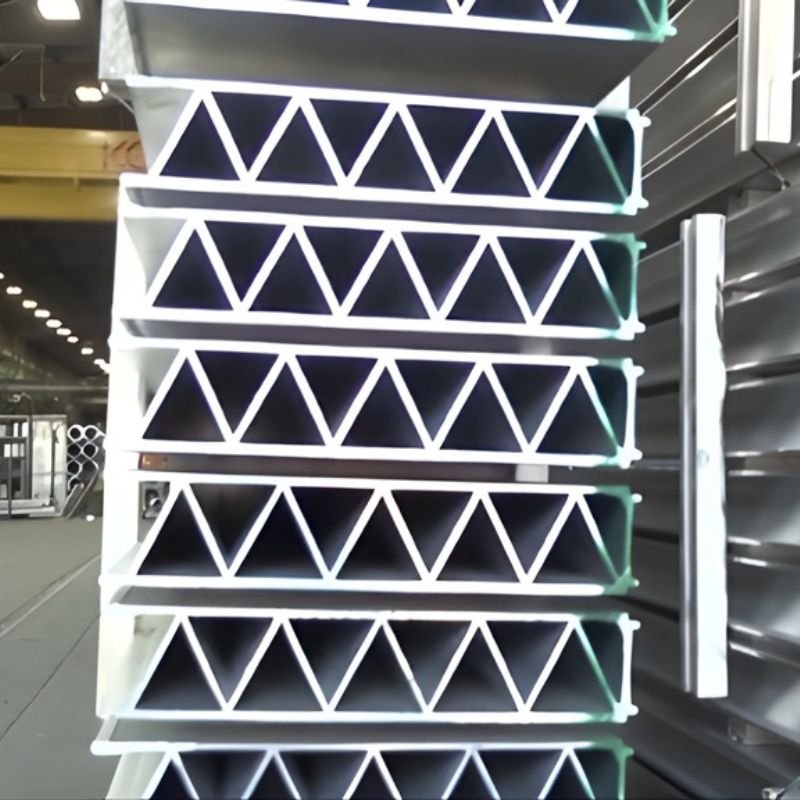
Thick-wall aluminum extrusions are needed when stiffness and load-bearing capacity must be achieved without secondary reinforcement. Defense platforms and infrastructure systems face dynamic loads and thermal cycling. Using thick-wall profiles ensures dimensional stability is maintained.

Similarly, wide-profile aluminum extrusions provide large-scale structural support. In shipbuilding, broad sections allow continuous deck beams and superstructure components to be produced with fewer joints. Assembly is streamlined, improving structural continuity and reducing maintenance risk. Material continuity is emphasized in government shipbuilding standards, especially for vessels with long service lives.

Research on alloys such as 6061 shows that properly processed extrusions retain mechanical integrity under demanding conditions. In fact, a peer-reviewed study confirmed that performance is maintained even under environmental stress. Consequently, wide aluminum profiles combine structural reliability with manufacturability, reducing lifecycle costs for infrastructure and marine applications.

Why Press Size and Container Capacity Define Infrastructure Readiness

Only select extrusion facilities can produce structural aluminum profiles at infrastructure scale. Press size and container capacity set the limits for maximum profile width and alloy consistency in a single extrusion.

For example, a 16-inch press with 20-inch and 28-inch containers allows wide structural members and thick-wall profiles to be produced. These dimensions often exceed standard commercial equipment limits. Without sufficient press tonnage, multi-part assemblies must be used, which adds fabrication steps and raises quality risks. Structural-scale extrusion, however, ensures members are dimensionally stable as-extruded.

Additionally, when paired with integrated aluminum fabrication services, extrusions become complete systems. Advanced joining techniques, such as friction stir welding, are employed to create high-strength joints that surpass traditional fusion welding. In many defense applications, performance advantages of these methods have been documented in industry publications.
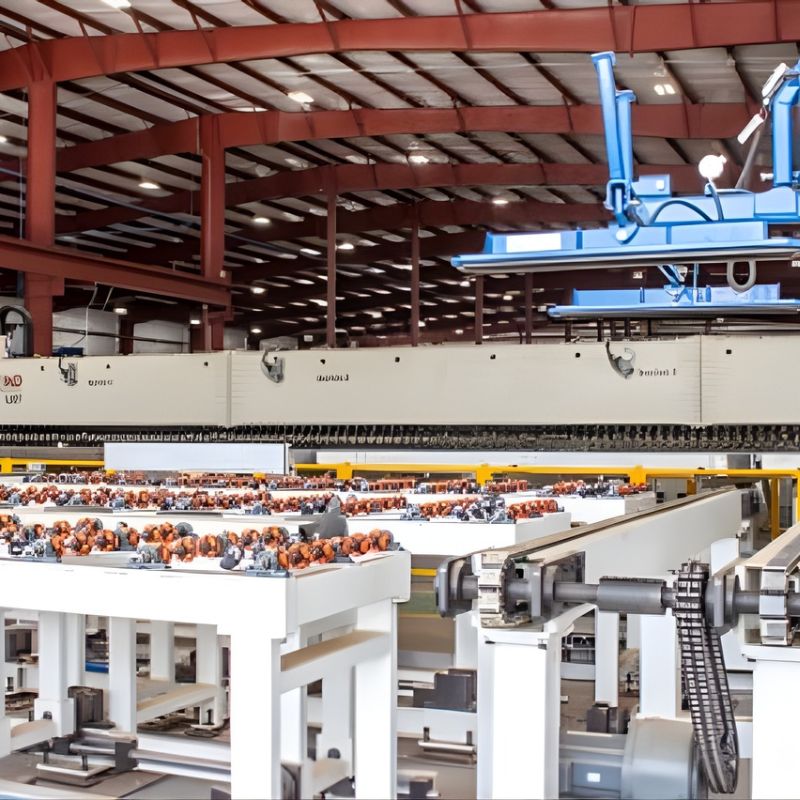
Friction stir welding equipment on an industrial floor processing large aluminum extrusions for defense and marine applications.

Compliance, Traceability, and Domestic Manufacturing Alignment

Aluminum extrusions for government contracts must comply with strict standards for material traceability and domestic sourcing. For structural-scale profiles, process control becomes even more critical, and profile size and mechanical consistency must be maintained across heavy cross-sections.

Congressional reporting on the defense industrial base highlight aluminum extrusions as a key element of domestic manufacturing. National security relies on manufacturers capable of delivering precision-engineered components within U.S. borders.

Therefore, procurement professionals should assess extrusion size capabilities and integrated production systems, including billet casting and quality management. Suppliers that control the full production chain help minimize supply risks for long-term government infrastructure programs.

What Infrastructure Buyers Should Evaluate

When sourcing large aluminum extrusions for military, naval, or government infrastructure applications, decision-makers should assess:

  • Maximum press size and container capacity.
  • Ability to produce thick-wall aluminum extrusions.
  • Alloy range and metallurgical control.
  • Integrated aluminum fabrication services.
  • Experience with defense and infrastructure programs.
  • Compliance with government contract documentation standards.

These criteria define manufacturing capability and long-term infrastructure performance.

Why Taber Extrusions Fits These Requirements

Where does Taber Extrusions fit in? The company supports defense and government infrastructure programs by producing structural aluminum extrusions at its Russellville, Arkansas facility. Equipped with 16-inch press capacity and 20-inch and 28-inch containers, the operation can produce wide sections and thick-walled components that meet infrastructure-scale requirements.

Taber operates an integrated production platform that features an aluminum casthouse, extrusion operations, and friction-stir welding capabilities. Vertical integration supports alloy control and compliance documentation across defense aluminum manufacturing programs.

Stakeholders can review Taber’s full capabilities overview to understand available extrusion sizes and alloys: https://taberextrusions.com/taber-extrusions-capabilities/
Looking for large aluminum extrusions built for government, military, or marine applications? Work with an extrusion partner equipped to handle wide profiles, thick walls, and demanding compliance requirements without compromising precision or delivery.

Fill out the form below to get started with Taber Extrusions.

Request A Quote

    CONTACT INFORMATION

    YOUR PROJECT NEEDS

    Please specify extrusion alloy and length below

    If you have design files for extrusion or FSW please upload below

    Excepted file formats: jpg, pdf, png.

    Please specify FSW alloy class, welding type and panel dimensions below.

    Alloy*

    Welding Type*

    Select Billet Size *

    ANY CUI OR FCI DATA IS STRICTLY PROHIBITED FROM BEING UPLOADED DIRECTLY THROUGH THIS FORM. IF YOU NEED TO SHARE ANY SENSITIVE DATA PLEASE CONTACT A TABER SALES TEAM MEMBER AND THEY WILL PROVIDE A SECURE METHOD OF SHARING ANY SENSITIVE INFORMATION.

    26 07, 2023

    Aluminum Extrusions for Military & Defense

    2023-07-26T00:20:21+00:00July 26th, 2023|

    Classic black and white background featuring a huge, docked battleship on the left and on the right, viewed from their backs are a line of soldiers. In the foreground is a gradient blue banner featuring the blog title and the Taber logo at the bottom left corner.

    One of the great presidents of the United States, Theodore Roosevelt, once said, “Speak softly and carry a big stick; you will go far.” I cannot describe how this quote perfectly captures the essence of diplomacy and military readiness. This quote highlights the importance of strength and resolve in achieving one’s goals. For this reason, Taber is proud to support our nation through aluminum extrusions in military and defense.

    In today’s world, military strength and readiness play a critical role in maintaining peace and security. Exploring the latest technologies and materials that can give our armed forces an edge is essential. One industry that has become increasingly important in the defense and military sectors is the Aluminum extrusion industry.

    Aluminum extrusions are widely used in various defense and military applications.  This includies aerospace and aircraft construction, armored vehicles, and weapons systems. Aluminum is a lightweight yet solid material that offers several advantages over other metals. Resistance to corrosion, excellent strength-to-weight ratio, and the ability to be shaped easily into complex geometries are just a few examples.

    Nations worldwide continue to invest in their defense and military capabilities. As a result,  Aluminum extrusion has emerged as a critical technology in pursuing high-level defense capabilities and superiority.

    Colored elegantly in sepia is a calm river and leading them as they walk in the grassy banks is a young woman, a boy, and a girl. The woman holds a large stick resting on her shoulders, with tiny birdhouses made of wood dangling on a string. The quote, “Speak softly and carry a big stick; you will go far.”, is beautifully written in cursive on a gradient blue vertical banner with Theodore Roosevelt’s name and the Taber logo underneath it.

    Keeping Peace Through Aluminum Extrusion in Military & Defense

    The defense and military sectors play a vital role in maintaining national security and stability. Various branches such as the Army, Navy, Air Force, and Marine Corps are a part of those sectors. Aluminum extrusion, a process of shaping aluminum into desired profiles and shapes, is vital in supporting these branches.

    Through the years, critical innovations through research and development allowed endless applications widely used today. To name a few of those benefits and applications brought about by the aluminum extrusion process:

    Lightweight and Durable

    Using aluminum extrusions has created lightweight yet solid structures for military vehicles and aircraft. Reducing the weight makes them more fuel-efficient and easier to transport. It also provides a lightweight alternative to traditional armor and vehicle components without sacrificing strength or durability.

    Design Flexibility

    Aluminum extrusion technology creates complex shapes and profiles that cannot be achieved with other manufacturing processes. This flexibility in design enables engineers to create parts optimized for specific military applications and perform better than alternative materials.

    Improved Thermal Management

    Aluminum extrusions can create heat sinks, which help dissipate heat from sensitive electronic components in military equipment. This is especially important in military applications where electronic equipment must function under extreme conditions.

    Reduced Maintenance

    Aluminum is naturally corrosion-resistant, making it ideal for applications where extreme conditions make a material vulnerable to weathering. The extrusion process creates a protective oxide layer on the aluminum’s surface, enhancing its corrosion resistance. This is especially important in marine and naval applications where equipment is exposed to saltwater and other harsh conditions, such as in space.

    Cost-efficiency and Sustainability

    Aluminum is a fully recyclable material compared to other metals — it requires less energy to extract and manufacture, making it a more environmentally friendly option. Additionally, aluminum extrusion is an efficient process that minimizes material waste and energy consumption, reducing overall environmental impact. Its sustainability and eco-friendliness make it a desirable choice for manufacturers looking to reduce costs and minimize carbon footprint.

    Framed in a gradient blue, white, and red ribbon are a sophisticated circuit board, an air-cushioned vehicle at sea carrying armored vehicles, a white satellite above the earth, a modern multi-purpose armored military vehicle driving on a field, and a full view of the USS Nimitz at sea.

    As we celebrate our nation’s independence, we at Taber understand the significance of robust defense and military capability, as highlighted by President Roosevelt’s famous quote. We recognize that diplomacy and military readiness are crucial factors in ensuring peace.

    While Taber Extrusions serves various industries, we’ve maintained a solid foundational market in the military and defense sectors. This dates back to the mid-60s when our Russellville, Arkansas facility was built to manufacture AM2 Landing mats for the US military that are widely used worldwide as landing strips on which all military aircraft land.

    Today, Taber products are used in every military branch and even the US Coast Guard, supporting military efforts worldwide — including shipbuilding, infrastructure, tanks, mobile armor equipment, and more.

    Our Appreciation Through Aluminum Extrusions in Military & Defense

    As a long-time domestic provider of high-quality aluminum extrusion products and services to our military and defense departments, Taber’s support for our nation does not stop there. We also recognize our veterans and their valuable skills and experience, including leadership, teamwork, and strong work ethic.

    Over the years, we’ve been actively seeking out and hiring military veterans to support their journey after the heroic service they gave our nation. One of our core is to provide equal opportunities to hardworking, passionate individuals from various backgrounds.

    To our heroes and their families, who willingly sacrificed and continue to serve our country for the greater good, we offer our utmost respect and gratitude for your service.

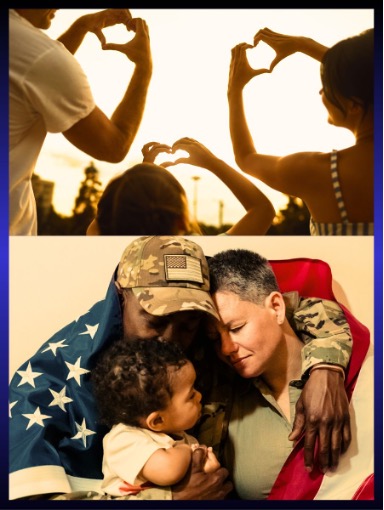
    Framed in a gradient blue background are two families. At the top is a family of three, with the dad, mom, and daughter in the middle, holding their hand heart on the sunset sky. And, on the bottom is a military family with dad and mom hugging their son in the middle and the American flag shrouded on them.

    More About Taber Extrusions

    Taber Extrusions, located in Russellville, AR., and Gulfport, MS., is a highly regarded provider of aluminum extrusions to various industries, including aerospace, infrastructure, transportation, defense, and thermal management.

    ISO 9001 and AS 9100 certified, Taber’s present and future customers can expect increased supply opportunities with the expanded set of extrusion solutions, programs, and services.

    Founded in 1973, Taber Extrusions originally pioneered a process for extruding rectangular billet, which enables the company to extrude solid profiles up to 31 inches wide or hollows up to 29 inches. Taber expanded with the purchase of an extrusion facility in Gulfport, MS., in 1995, which houses a new state-of-the-art cast house and two additional presses, micro-extrusion capabilities, and the fabrication area has been expanded multiple times. We continue to extrude billet in a wide range of alloys and sizes. We have diversified our markets beyond the military since our inception to include aerospace, automotive, marine, infrastructure, and sporting goods, among many others.

    Our company supplies cast and extruded products in various soft and hard alloys for these markets.

    Today, Taber Extrusions is proud of its friction stir welding capabilities and a complete offering of extruded aluminum components, value-added machining services, and raw material supply to the North American market.

    Thank you for your continued support of Taber Extrusions, LLC. If you have any questions, please visit taberextrusions.com or contact one of our Regional Sales Representatives.


    Follow Taber Extrusions:

    LINKEDIN: https://www.linkedin.com/company/taberextrusions/

    FACEBOOK: https://www.facebook.com/taberextrusions/

    TWITTER: https://twitter.com/taberextrusions

    Interested in becoming a part of the Taber Team? Submit your resume to careers@taberextrusions.com.

    3 05, 2022

    Aluminum Extrusions for Military Marine Application

    2022-07-06T22:22:47+00:00May 3rd, 2022|

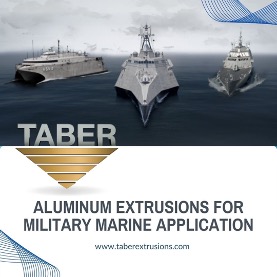
    A graphic depiction of three different military ships at sea with Taber Extrusions’ inverted gold triangle logo on the lower left corner, the words, “Aluminum Extrusions for Military Marine Application” and Taber’s website address are centered at the bottom of the image: www.taberextrusions.com.

    With all the possibilities of technical advancement, there are endless ways to be innovative these days. With that in mind, what is the significance of technology and innovation in shipbuilding? We can go back to the American Civil War in 1862, wherein two ironclad warships battled for the first time. Not one ship sunk; thus, both parties claimed victory.

    For naval technology, this was an important milestone. Why? Because ironclad warships had shown an increase in survivability compared to their wooden-hulled predecessors. Presently, the battlefield is evolving faster than ever and the need has emerged for a new breed of warships with increased speed, agility, and stealth.

    Look no further! The answer is aluminum.

    5xxx aluminum alloys

    Aluminum allows vessels to be made lighter and faster at one-third the density of steel. The corrosion resistance and strength of new alloys, especially the 5xxx series of aluminum alloys, make it an ideal choice for constructing sea-going vessels. Adding elements to pure aluminum produces a chemical composition with improved properties creating an aluminum alloy that increases strength. A 4-digit number is then assigned in which the first digit represents a general series that characterizes its main alloying elements.

    The primary agent for the 5xxx series is magnesium which gives the alloy strength and good weldability, amongst other things. In naval ships alone, 6,000 tons of aluminum are used each year on destroyers. For more than a decade now, 5456 plate and extrusions have become the benchmark for the welded deckhouse structures of destroyers. The weight-saving ability of the 5xxx series allows the ship to maintain stability with a narrow hull that is crucial in reaching high speeds.

    Advantages of 5xxx aluminum alloys

    The structures save 55-67% of their weight by using a 5xxx aluminum alloy. The ships can increase payload, haul more equipment, and lower the energy required to power the boat. The 5xxx series has good weld ductility without post-weld treatments due to the weld yield strengths of 100-200 MPa. It has lower corrosion resistance which is ideal for any structure encountering water or chemicals. The tensile strength of the alloy showed reductions of only 2-5% throughout a 10-year seawater test.

    An ominous photo capturing an overcast day with a Naval frigate ship traveling at a high speed through the ocean leaving a wake of frothy white waves in the deep blue sea.

    Friction stir welding for marine vessels

    The growth of new metal forming processes, friction stir welding (FSW) chief among them, has made aluminum one of the most versatile materials, creating profiles. For more than twenty years, friction stir welding or FSW has been a highly effective alternative to traditional MIG welding in marine applications. It is best used on long straight welds for a more cost-effective and efficient operation.

    Several of the welded structures in this process are alloyed aluminum extrusions. Flat designs used in the marine industry, such as floors, decks, bulkheads, and parts that do not require complex curves, can be done by FSW. These vessels are capable of speeds of more than 45 knots (51 mph), an exceptional rate for vessels that weigh 3,500 tons. Even hull sections are critical to making the vessels lighter, faster, and more maneuverable.

    Taber Extrusions’ Russellville, Arkansas friction stir welding production cell inside the facility.

    Benefits of friction stir welding for marine vessels

    • Speeds up the building procedure and saves money for large and small projects.

      The cost savings come from eliminating the required person-hours of traditional MIG welding and providing a more substantial, higher quality weld, which cuts down on secondary repair costs. Using complete components such as modular FSW panels reduces the time and labor costs of measurements and cutting on the construction site. There is also minimal distortion on the weld and better aesthetics. It is more environmentally friendly (no UV radiation or fumes) and more user-friendly.

    • Removes flaws that are inherent to conditional welding methods.

      Characteristics include no porosity, no hot cracking, and a more robust fusion of the constituent elements. Becoming adopted far and near, FSW is less susceptible to errors due to the automated process.

    Six photos of ships neatly aligned in two rows of three: Small Surface Combatants, Patrol Vessels, Expeditionary Fast Transport, Offshore Platforms, Cruise Ships, Civilian Transports – with the words “MARINE AND NAVAL” prominently at the top of the graphic in a bold black font.

    Aluminum can help marine manufacturers and shipbuilders obtain weight and production savings and improve the quality and efficiency of vessels and structures… and the unique qualities of extruded aluminum component design provides exceptionally high torsion strength resistance – making it the ideal material for marine application.


    More About Taber Extrusions

    Taber Extrusions, founded in 1973, originally pioneered a process for extruding extra-large aluminum extrusion profiles up to 31 inches wide or hollows up to 29 inches. Taber expanded with the purchase of an extrusion facility in Gulfport, MS, in 1995. It houses a state-of-the-art cast house and two additional presses, microextrusion capabilities, and the fabrication area, which has been expanded multiple times.

    Taber continues to extrude billet in a wide range of alloys and sizes. It also has diversified its markets beyond the military since its inception to include aerospace, automotive, marine, infrastructure, and sporting goods, among many others. With in-house casting solutions, ultra-precision extrusion manufacturing, friction stir welding capacities, and a full range of hard and soft aluminum alloys, Taber aligns itself as an industry leader in having the broadest available capabilities.

    Today, Taber Extrusions is proud of its recently added VF-12 CNC machining line and a complete offering of extruded aluminum components, value-added machining services, and raw material supply to the North American market. Adding these capabilities to a growing portfolio drives Taber into the future in a pursuit to continuously enhance the quality and service we provide to our customers.

    We appreciate your ongoing support of Taber Extrusions, LLC. If you have any questions, please visit taberextrusions.com or reach out to one of Taber’s regional sales managers.

    Follow Taber Extrusions:

    LINKEDIN: https://www.linkedin.com/company/taberextrusions/

    FACEBOOK: https://www.facebook.com/taberextrusions/

    TWITTER: https://twitter.com/taberextrusions

    Go to Top