17 07, 2018

Infrastructure Applications of 6xxx Series Aluminum Alloys

2018-07-18T16:49:28+00:00July 17th, 2018|

It is estimated that 56,000+ bridges are structurally deficient in America with an estimated $123 billion in rehab needed. The solution? The 6xxx Series Aluminum Alloys. Not only can they be used for emergency repairs but they can provide a long-term solution to this infrastructure problem with minimal maintenance required.Let us review what sets this alloy apart, its advantages, and the types of projects the alloy is best suited for.

What is an aluminum alloy?  

Aluminum alloys are created by taking aluminum and adding elements, creating chemical compositions with enhanced properties. Once created, these compositions receive a 4-digit number with the first digit signifying a general series that characterizes its main alloying elements.

What does it mean when an alloy is a part of the 6xxx series

The main agents in the 6xxx series are silicon and magnesium in order to form magnesium silicide within the alloy. Alloy 6061 is the most commonly used of the series, typically used in truck and marine frames.

What are the advantages of the 6xxx aluminum alloys?

  • High Corrosion Resistance – 6xxx series aluminums can withstand abrasion, keeping their strength and durability in a variety of environments. This is one of the appeals to using it in infrastructure and architectural projects that hope to create structures with the intent of lasting decades. Whether its receiving harsh sunlight in the Nevada desert or nearly year round rain in Seattle, the alloy is able to hold up.
  • Extrudablitity – A unique feature of the 6xxx series is its extrudability. The ability to make specific, extruded parts from the alloy is another factor in why architectural and infrastructure members use this alloy. They typically require unusual, high-strength components and the power of extruded of 6xxx series is its ‘place-metal-where-you-need-it’ flexibility.
  • Heat treatable, weldable, flexible – 6061 is a highly weldable alloy, using tungsten insert gas welding or metal inert gas welding. After welding, the properties near the weld are those of 6061-O (a loss of strength of around 80%). However, MIG and TIG welded material can be heat treated again to bring the material back to the pre-welding temper. Another option may be Friction Stir Welding (FSW). With FSW, the profiles are joined together through the use of a specialized rotary machine tool. Although the material is heated and joined together through friction, the overall heat applied to the material is much lower and of shorter duration than MIG or TIG welding and the heat affected zone is much less and retains most of the original strength.

What are the applications of the 6xxx Series Aluminum Alloys?

It is this combination of advantages that make 6xxx Series Aluminum Alloys prime candidates for architectural and infrastructure projects. Such projects include:

  • Bridges or aluminum bridge decking: Extruded aluminums can be used to build traditional bridges or bridge decks can be pre-built in a modular fashion and moved to bridge sites. This method can limit the amount of time that bridges are under construction and save money in the long run.
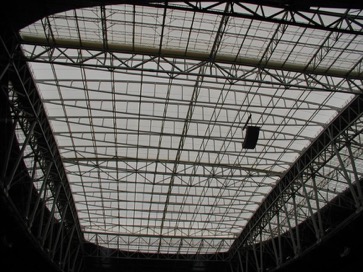
  • Roof Structures: Typically implemented for arenas and gymnasiums, the 6063 or 6061 extruded tubes are used in large scale roofs with 5xxx alloy sheets covering them.
  • Pipelines: Because of their high corrosion resistance the 6xxx series is great for pipeline systems that have possibly acidic or dangerous materials flowing through them.
  • Automotive: Whether for a car, motorcycle, bus, or train, the 6xxx series is often used in the automotive industry for its high dent resistance and durability.

Taber Extrusions recognizes the hard work and precise engineering required for large-scale infrastructure projects. Capable of producing very large aluminum shapes with our exclusive 10” x 28” rectangular container along with our 16” and 20” round containers, we canconsistentlysupply our customers with some of the widest, most complex multi-void hollows in the industry. Taber produces their 6xxx series alloys in-house, and our recent investments in our casting and fabrication capabilities have poised Taber to be a great fit for any of your architectural and infrastructure needs… and a reliable partner for all aspects of your project.

Recent upgrades to our aluminum cast house and aluminum fabrication capabilities have put Taber in the perfect position to do just that. Check out our video on Aluminum Extrusions for Infrastructure Projects.

To learn more about how we can be of service visit: https://taberextrusions.com/

For inquires or quotes visit: https://taberextrusions.com/contact-us/

Follow Taber Extrusions

LINKEDIN: https://www.linkedin.com/company/8843183/

FACEBOOK: https://www.facebook.com/taberextrusions/

TWITTER: https://twitter.com/taberextrusions

Interested in becoming a part of the Taber Team?  Submit your resume to careers@taberextrusions.com.

5 07, 2018

Marine Applications of 5xxx Series Aluminum Alloys

2018-07-05T21:24:40+00:00July 5th, 2018|

The applications of the 5xxx series aluminum alloys range from shipping containers to their most prolific application, boats. Whether building a recreational boat, commercial ship, or naval vessel, the advantages that the 5xxx series of aluminum alloy have, make it the premier building material for anything marine related. Before we ‘dive’ into the specific advantages of the 5xxx series and it applications, lets break down what aluminum alloys are and what sets the 5xxx series apart.

What is an aluminum alloy and what does it mean when an alloy is considered part of the 5xxx series?

Simply, an aluminum alloy is created by adding elements to pure aluminum, creating a chemical composition that has enhanced properties (typically to increase strength). Once these compositions are created they are assigned a 4-digit number where the first digit signifies a general series that characterizes its main alloying elements. For the 5xxx series, its main agent is magnesium which gives the alloy high strength as well as good weld ability amongst other things.

What are the advantages of 5xxx aluminum alloys?

  • Weight Saving: By using 5xxx aluminum alloy, structures save an average of 55 to 67% of their weight. With comparable strength to mild steel, the alloy’s ability to decrease a structures weight can be hugely beneficial, especially for marine vessels. By saving weight the boats can increase payload, haul more equipment, and lower the amount of power required to power the boat.
  • Weld ability: With weld yield strengths of 100 to 200 MPa, the 5xxx series have good weld ductility without post weld heat treatments.
  • Corrosion resistance: The 5xxx series has lower resistance to corrosion making it ideal for any structure that will be coming in contact with water or chemicals. Through a 10-year seawater test, the tensile strength of the alloy showed reductions of only 2 to 5%.

What are the marine applications of 5xxx Series Aluminum Alloys?

  • Pleasure Boats: Made from both 5xxx and 6xxx series aluminum alloys, pleasure boats utilize the alloys ease of fabrication, corrosion resistance, and cost effectiveness for building their hull or other equipment.
  • Commercial ships: Many passenger vessels utilize the 5xxx series for both superstructures and equipment; ranging from 1000 to 2000 tons per ship. Since for many ocean liners appearance is important, the structures are painted but aluminum allows for a 50% longer time frame till repainting.
  • Naval Vessels: Each year, 6000 tons of aluminum is used on destroyers. Within the past decade, 5456 plate and extrusions have become the standard for the welded deckhouse structures of destroyers. The weight saving ability of the 5xxx series allows the ship to maintain stability with its narrow hull that is needed to reach high speeds. Beyond the main structure, the alloy can also be employed for a variety of equipment including doors, windows, gratings, lockers, bunks, etc.

It is the use of the aluminum alloys that has allowed the marine industry to undergo a technological revolution. While the aluminum may have an initial cost premium, its ability to create lighter ships with lower maintenance costs means that the ship will be a worthwhile investment over the course of its life. And though boats may not be the first thing you think of when discussing the application of an aluminum alloy, the 5xxx series aluminum alloy has transformed the marine industry for the better.

25 06, 2018

Taber Extrusions, LLC. Metal Pricing Policy Update

2018-06-25T21:33:12+00:00June 25th, 2018|

Due to ongoing pricing volatility in the overall metal market, Taber Extrusions, LLC of Russellville, Arkansas and Gulfport, Mississippi, is changing its metal pricing policy. Effective with Orders on and after April 16, 2018, and Shipments on and after May 1, 2018, all invoices will be updated to reflect the Prior Months Midwest Transaction Average at the time of shipment.

Company History: Taber Extrusions, LLC.

Taber Extrusions was founded in 1973, when the Taber family acquired an aluminum extrusion plant in Russellville, AR, from Dow Chemical (which had originally built the plant in 1970). National Material Company L.P. (NMLP) later purchased the company in 1976. The Arkansas facility was originally dedicated to the production of specific military related large, wide, and long extrusions for the U.S. Government, for which the company pioneered a process for extruding rectangular billet (or slab). The use of rectangular billet enables the company to extrude solid profiles up to 31 inches wide or hollows up to 29 inches.

In 1995, Taber expanded with the purchase of an extrusion facility in Gulfport, MS, which houses a cast house and two additional presses. Fabrication capabilities were added to the Russellville facility in 2014, which already houses the company’s large 8,600 MT press with three container sizes (a container for the extrusion of rectangular billet, as well as two round containers, a 16 inch and a 20 inch). The fabrication area has been expanded several times since it was constructed, with the addition of  B-800 series and Marvel band saws for precision cutting, horizontal and vertical machining centers, and coordinate measuring machine (CMM) for quality control.

To this day, the company continues to extrude billet in a wide range of alloys and sizes, including for the same military program, which remains one of the company’s biggest customers. However, Taber has diversified its markets since its inception to include aerospace, automotive, marine, and sporting goods, among many others. For these markets, the company supplies cast and extruded products in a variety of soft and hard alloys.  (Sourced from Light Metal Age Magazine)

Thank you for your continued support of Taber Extrusions, LLC. If you have any questions concerning this policy change please contact one of Taber’s Regional Sales Managers.

22 06, 2018

Medical Microextrusions | Process, Benefits, and Examples

2018-06-22T22:04:25+00:00June 22nd, 2018|

medical microextrusions

Advancements in medical microextrusions technology in recent years have allowed manufacturers to create high quality products for the world of medical OEMs. With a range of dimensions that can reach as small as 0.024 in., OD with up to 6 lumens, and an ID range that can reach 0.003, it’s no surprise that many OEMs are turning to companies like Taber Extrusions that can provide products within these parameters. (Source: medicaldesignbriefs.com)

In fact, micro-sized medical components are quickly becoming crucial to modern hospital safety and cost-efficiency. Whether it be for micro-tubing or micro sized components, the microextrusion process provides a number of benefits to engineers, OEMs, and patients.

In the quest to create higher quality medical devices, companies are looking to enhance existing products (including catheters and precise flow restrictors) through miniaturization, while ultimately reducing the costs of production.

Medical products that utilize microextrusion technology overwhelmingly support cardio-and-neurovascular procedures, drug delivery, IV procedures, and other procedures that require work on a micro level.

By minimizing the impact of invasive procedures, the medical industry can reduce complications, make procedures faster and more efficient, and ultimately reduce patient in-time and overall healthcare costs.

WHAT’S THE MICROEXTRUSION PROCESS LIKE?

Manufacturing the miniature components used in a medical microextrusion device poses a unique challenge for microextrusion providers. These components cannot be created using conventional extrusion machinery. Instead, they require precise, state-of-the-art equipment that allows for a high degree of precision and control over the process, as well as Engineers and technicians that possess deep knowledge of both the material and the process itself.

However, at its core, the process is similar to that of regular extrusion.

The material is either pushed forward (direct) or pulled through (indirect) a die orifice to create the shape required. Unlike macro-level extrusions, microextrusions are extruded at a very slow rate to maintain the physical properties of materials that are often delicate.

Done properly, microextrusions can create end products that have complex cross sections and preserved chemical properties.

BENEFITS TO OEMs

Lower Time-to-Market

In years previous, OEM’s requests for medical products would require them to re-outfit their existing extrusion machines, which would take more time and far less efficient. With many manufacturers outfitting themselves with microextrusion machinery, the time required to create the product is drastically reduced.

Lower Costs

As stated above, microextrusions can achieve their desired performance at fractions of the cost, due to the lower cost in materials that are used. As the development of the technology continues to improve, so to do the devices that are used in tandem with them. (i.e fibre optic cable, sensors, stints, etc.)

Psychological benefit to patients

A patient’s positive mental state can be a great asset to their recovery. Waning are the days of large, invasive medical devices that can cause patients discomfort. Smaller, less intrusive devices can go a long way. (source: Medical Plastic News)

POTENTIAL APPLICATIONS

  • Infant/paediatric care
  • Heart leads
  • Neurological
  • Vascular Surgery
  • Catheters
  • Radiology
  • Urology
  • Oncology

About Taber Extrusions

Founded in 1973, Taber Extrusions originally pioneered a process for extruding rectangular billet which enables the company to extrude solid profiles up to 31 inches wide or hollows up to 29 inches. Taber expanded with the purchase of an extrusion facility in Gulfport, MS in 1995 which houses a new state of the art cast house, two additional presses, and a fabrication area that has been expanded multiple times. Taber continues to extrude billet in a wide range of alloys. and sizes.

Taber Extrusions has recently purchased the Exact Manufacturing division of Lou-Rich, Inc. which will now expand Taber’s capabilities to include ultra-precision aluminum extrusions®.

Today, Taber Extrusions is proud to announce expanded capabilities to include aluminum ultra-precision extrusions®.

Follow Taber Extrusions

LINKEDIN: https://www.linkedin.com/company/8843183/

FACEBOOK: https://www.facebook.com/taberextrusions/

TWITTER: https://twitter.com/taberextrusions

Interested in becoming a part of the Taber Team?  Submit your resume to careers@taberextrusions.com.

29 05, 2018

Taber’s Growing Fabrication and Machining Capabilities

2018-06-26T16:27:16+00:00May 29th, 2018|

For decades, the aluminum extrusion experts, Taber Extrusions, have served customers in a wide variety of industries. New technological advancements and emerging industries inspired Taber Extrusions to upgrade and increase their facilities and capabilities, allowing the company to meet the needs of a larger customer base.

The new fabrication facility at Taber’s Russellville, Arkansas location features CNC (computer numerical control) machining. The move to CNC machining allows more precision and control over machine operations resulting in improved product quality.

Taber has added several new pieces of equipment to the new facility including the Haas VF-7, the Emmegi Satellite XT, the HMC500, and the ZIESS CMM. The new facility also houses precision saws that increase cutting precision and decreases scrap material.  The B&O B-800 series and the Marvel Band Saw are featured.

With the new fabrication and machining capabilities, Taber Extrusions has the ability to meet the needs of customers in industries that require the most cutting-edge technology, such as electric vehicles for individual and mass transportation.

24 05, 2018

Aluminum Extruders Engaging New Generation of Frigate Builders and Defense Contractors

2018-05-24T18:09:11+00:00May 24th, 2018|

The U.S. Navy is prepared to spend a generous amount in order to meet its ambitious specifications list as it prioritizes its FFG(X) program.  Recently, the U.S. Navy  announced they are willing to spend roughly $1B per ship, which should buy a very capable surface combatant. With this news, aluminum extrusion manufacturers are eager to provide extrusions for selected frigate designers/builders.

Read all about this and the requirements set by the Navy for the FFG(X) in this recent article by Tyler Rogoway of The Drive, which says “Defense contractors from around the globe are seeing this program as a rare opportunity to get a foothold in shipbuilding for the U.S. Navy, and multiple existing foreign designs could potentially be adapted for the Navy’s use. This is in addition to well-established domestic vendors that will be competing for the opportunity with their own designs as well. Supposedly about eight designs are being looked at by the Navy, all of which were submitted following the service’s initial RFP that was released last year.”

“This is an effort to get the design right up front,” Rear Adm. Ronald Boxall, The Navy’s surface warfare director said in an interview with Defense News. “We’re looking to have a dialogue with industry to get the most capability for the best price…. we want to see what industry comes back with. From there we’ll lock it down and go into the detailed design and construction phase and we can get this thing out by 2020.”

Who are the companies that have been contracted by the Navy to compete for the frigate bid?

  • Huntington Ingalls Industries, Pascagoula, Mississippi
  • Lockheed Martin Corp., Rotary and Mission Systems, Liverpool, New York
  • Bell Helicopter Textron Inc., Fort Worth, Texas
  • Detyens Shipyards Inc., North Charleston, South Carolina
  • Austal USA LLC, Mobile, Alabama
  • Lockheed Martin Inc., Baltimore, Maryland
  • Marinette Marine Corp., dba as Fincantieri Marinette Marine, Marinette, Wisconsin
  • General Dynamics Bath Iron Works, Bath, Maine
  • Nexagen Networks Inc., Marlboro, New Jersey
  • Adept Process Services Inc., National City, California

Aluminum extrusions have played a part in military and defense industries for a long time, and known for their contribution to the U.S. Navy’s the Littoral Combat Ships.  The LCS are agile and flexible surface combatants which operate close to shore, reconfigurable for various duties from special operations, maritime intercept, anti-submarine warfare, and reconnaissance. The Aluminum Extruders Council explains, “With design criteria stressing agility, it’s not surprising that extruded components, with their high strength and light weight, play an important role in the LCS program. Among other applications, truss sections, joined with friction stir welding, are used for decking, and T-sections, again joined via friction stir, are incorporated in the hull and superstructure.”

It will be exciting to see which ship will become the U.S. Navy’s next frigate, and what 2020 will bring.

About Taber Extrusions

Founded in 1973, Taber Extrusions originally pioneered a process for extruding rectangular billet which enables the company to extrude solid profiles up to 31 inches wide or hollows up to 29 inches. Taber expanded with the purchase of an extrusion facility in Gulfport, MS in 1995 which houses a cast house, two additional presses, and a fabrication area that has been expanded multiple times. Taber continues to extrude billet in a wide range of alloys and sizes, and has diversified its markets beyond military since its inception to include aerospace, automotive, marine, infrastructure, and sporting goods, among many others. For these markets, the company supplies cast and extruded products in a variety of soft and hard alloys. Today, Taber Extrusions is proud to announce the launch expanded capabilities to include aluminum micro-extrusions.

If you have any questions please visit taberextrusions.com or contact one of Taber’s Regional Sales Managers. Taber Extrusions is committed to continue their legacy by saving clients time and money with custom aluminum shapes extruded with precision and the full range of aluminum alloys.

15 05, 2018

Hard and Soft Alloys for Aerospace and Firearms

2018-05-22T17:21:02+00:00May 15th, 2018|

Inside Taber Extrusion’s new state-of-the-art casthouse, aluminum billets are cast and extruded into a wide range of shapes and sizes.  Taber offers the full range of aluminum alloys, including, hard, soft, marine, and armor grade, a unique capability in the industry.

Taber’s capabilities allow the company to serve several industries, including aerospace and firearms. The hard alloys that are created are ideal for these industries due to their high strength and corrosion resistance.

Taber serves both relatively small and large firearm manufacturers, establishing unique profiles for each customer. Customers have the option of requesting custom shapes with unique specifications or purchasing from  Taber’s existing inventory.

To highlight some of the company’s services: Taber offers custom extrusions to be used in the manufacturing of AR-15 variant rifles.  The aluminum alloys used for these shapes are the same as those used in military grade jets. Taber can provide both oversized extrusions as well as shapated that are as small as 1 millimeter for manufacturing firearms.

Taber’s resumé includes service to all the major aerospace manufacturers in the U.S. The extruded shapes provided by Taber are used for important components of aerospace vehicles, including the fuselage/pressure cabin, seat/cargo tracks, lower and upper horizontal stabilization, and upper and lower wing skin/spars/stringers.  Another unique service offered by Taber, that is applicable to the aerospace industry, is large press, hard alloy extrusions.

With unique capabilities and decades of experience, Taber is the go-to company for all of your extrusion needs.

Contact Taber today: (888)-985-0763.

30 04, 2018

Taber Extrusions Announces Micro-Extrusion Capabilities Via Lou-Rich Exact Manufacturing Purchase

2018-05-11T22:54:53+00:00April 30th, 2018|

Taber Extrusions Announces Micro-Extrusions

Taber Extrusions of Russellville, Arkansas purchased the Exact Manufacturing division of Lou-Rich, Inc.  which will now expand Taber’s capabilities to include ultra-precision aluminum extrusions.

Aluminum ultra-precision extrusions are produced through a proprietary technique that delivers features, tolerances, and surface finishes previously believed to be impossible. This unique extrusion process continues to impress design engineers, offering an additional design alternative for the production of precision aluminum components. Industries most commonly using micro-extrusions include computer, electronics, aerospace, medical, industrial, and military.

“On behalf of Exact Manufacturing, I want to sincerely thank you for your business and patronage over the years, and wish you success in the future,” says Exact Manufacturing President Mike Larson, in a letter recently sent out to Exact Manufacturing’s current client base, asking them to direct all new purchase orders to Taber Extrusions, “The Exact Manufacturing division of Lou-Rich will continue fulfilling orders for Taber until a successful transfer of equipment and processes is assured.”

Taber is a highly regarded, full service provider of aluminum extrusions to many industries including aerospace, transportation, defense, power, etc.  They are also ISO 9001 and AS 9100 certified.  As a leader in the extrusion business, Taber is highly suited to provide the quality and service demanded by Exact’s customers.  With this acquisition, both Taber’s and Exact’s customers can expect to see increased supply opportunities with the expanded set of extrusion solutions, programs and services provided by Taber.

About Taber Extrusions

Founded in 1973, Taber Extrusions originally pioneered a process for extruding rectangular billet which enables the company to extrude solid profiles up to 31 inches wide or hollows up to 29 inches. Taber expanded with the purchase of an extrusion facility in Gulfport, MS., in 1995 which houses a cast house and two additional presses, and the fabrication area has been expanded multiple times. Taber continues to extrude billet in a wide range of alloys and sizes, and has diversified its markets beyond military since its inception to include aerospace, automotive, marine, infrastructure, and sporting goods, among many others. For these markets, the company supplies cast and extruded products in a variety of soft and hard alloys. Today, Taber Extrusions is proud to announce the launch expanded capabilities to include aluminum ultra-precision extrusions.

Thank you for your continued support of Taber Extrusions, LLC. If you have any questions please visit taberextrusionc.com or contact one of Taber’s Regional Sales Managers.

29 03, 2018

Beyond the Aluminum Extrusion – Full Service Aluminum Extrusion Company

2018-05-11T23:05:26+00:00March 29th, 2018|

Taber Extrusions has extrusions in the name, but it’s really a full-service aluminum extrusion company. Taber controls it all, from the casting of the billet, the extrusion process, fabrication and finally the logistics..

We have a commitment to meeting and exceeding customer expectations by providing both products and service levels that are of the highest quality. This commitment is at the core of our operating philosophy.

For us, these unique capabilities are key. Our specialty is the manufacturing of complex and intricate extrusions which competitors consider difficult or even impossible. Our full range of extrusion presses, from 1800 and 3000 ton to our impressive large 8600 ton, give us unmatched flexibility and profile capabilities to meet our customer’s needs.

For example:  our 8600 ton press, one of the largest extrusion presses in the United States, has the capability to extrude both 16 and 20 inch round billets, and 10” x 28” rectangular billets with a maximum circle size of 31” and up to 140 lbs. per foot. With the ability to extrude large, intricate configurations, such as lightweight but strong one-piece extrusions, the customer can incorporate whole assemblies of small components into one extruded part.

As your full-service aluminum extrusion company partner, Taber will work alongside you to turn a concept into reality. Taber’s remarkable attention to the needs of the market position us to provide customized, versatile, high-quality extruded and fabricated products that can satisfy a wide range of applications.

7 03, 2018

Fabricated Aluminum Bikes are Stronger, Faster, Lighter

2018-05-11T23:03:56+00:00March 7th, 2018|

Although aluminum is now the most prevalent material in biking these days, up until the 1980’s, most mountain bike frames were made of steel.

Slowly, the market demand for lighter, stronger, and rust-resistant bike frames coupled with advances in aluminum metallurgy led some manufacturers to make the switch. Soon, most steel-frame bikes had aluminum parts in the form of brakes, derailleurs, stems, lightweight wheels, handlebars, and seat posts.

It wasn’t long before most bike manufacturers switched entirely to aluminum!

Although both steel and carbon fiber have come a long way , aluminum bikes remain an enthusiast favorite.

In the modern era, advancements in alloying technologies are bringing aluminum bikes to new heights by amplifying their properties.

Weight:

Aluminum is the most widely available lightweight bike frame material. By comparison, steel bike frames have, on average, three times the weight of aluminum ones. Due to its naturally low weight, aluminum remains an ideal and affordable choice for racing and mountain bike frames.

Due to aluminum’s lower strength compared with steel, titanium, and carbon fiber, aluminum bike frame tubes often have thicker walls. Though this does not necessarily provide an advantage over other frame types, thicker-than-standard tubes can be used in aluminum bike frames without making them significantly heavier.

Carbon fiber, of course, has an edge on aluminum in terms of weight. But for a mountain biker, sometimes a little weight is a good thing.

Downhill racers often prefer aluminum over other materials. The additional weight and formability properties allow the rider to maintain the proper inertia to keep the bike steady and to maintain control at high speeds. Weighted aluminum frames make it easier to find the sweet spot.

Price:

Aluminum is a widely used material and is infinitely recyclable, so its price compared to other materials is very competitive.

Well-rounded, lightweight, and affordable, aluminum bike frames are the ideal choice for both beginner and expert-level mountain bikers.

Plus, aluminum is not prone to rust, unlike steel-framed bikes. This resistance makes aluminum a lasting and low-maintenance choice for mountain bikers and other riders who often expose their bikes to harsh elements.

Rigidity:

For trail and downhill riders, the somewhat flexible, forgiving nature of alloyed frames help provide comfort during extremely bumpy terrain or at high speeds.

Alloys Used in Mountain Bikes:

2xxx series: 2xxx series alloys are not usually used for frames. They are easily welded and heat-treatable, but are more suitable for use in components such as bars, seatposts and stems – parts that usually have less butting. Alloy types you will likely encounter are 2011, 2014 and 2024.

6xxx series: 6xxx series alloys are intermediate strength aluminum alloys. In general, they are weaker than either a 2xxx or 7xxx series alloy, but are more easily forged, machined, welded, and formed. You will find them usually in lower cost aluminum alloy frames. 6061, 6063 and 6082.

7xxx series: Most commonly found in the aerospace industry, 7xxx series aluminum alloys are an incredibly high strength alloy that exhibits great resistance to the outdoor elements. The most durable of all bike frames are made from this series’ alloys.

Go to Top