3 04, 2026

Inside the 10,000-ton Press Driving the Future of Aluminum Extrusion Profiles

2026-04-03T03:29:36+00:00April 3rd, 2026|

Digital circuitry background with icons of an airplane, naval ship, and excavator representing aerospace, marine, and heavy industrial aluminum extrusion applications.

Key Takeaways:

  • Engineering teams often face design limitations when sourcing large aluminum extrusion profiles, forcing compromises like welded assemblies, added weight, and increased failure points.
  • A 10,000-ton aluminum extrusion press removes these constraints, enabling larger, more complex, and monolithic profiles with tighter tolerances and improved structural performance
  • By combining high-tonnage extrusion with integrated fabrication, manufacturers can reduce assembly, accelerate production timelines, and deliver consistent, high-performance components for aerospace, defense, and heavy industry.

Aluminum extrusion profiles are redefining what is possible in modern aerospace, defense, and heavy industry manufacturing. Demand for integrated, monolithic structures now exceeds traditional fabrication limits. As a result, extrusion capability and available press force have become critical constraints. High-performance profiles require immense power and complex tooling; however, a 10,000-ton direct press changes the equation. Operating at unprecedented scale, it enables wider cross-sections, tighter tolerances, and the precise forming of hard alloys once considered impractical. Moreover, higher tonnage improves grain structure reliability, bridging the gap between ambitious design and manufacturable reality.

Why Press Size Matters for Aluminum Extrusion Profiles

Aluminum extrusion relies on controlled deformation. Billet temperature, alloy chemistry, die design, and press force determine final profile quality. When press capacity is limited, compromises such as thicker walls, segmented assemblies, secondary weldments, and longer lead times are often introduced.

A 10,000-ton press removes many of these constraints. Larger cross-sections can be produced, and tighter dimensional control is maintained. In addition, metal flow is kept uniform across wide or complex profiles. This capability is essential in aerospace manufacturing, where long structural members reduce fasteners and failure points. Likewise, in defense manufacturing, strength-to-weight ratios and repeatability must be achieved without variation.

Other advantages include more refined grain structure due to the higher force, as well as improved mechanical consistency. For heavy industry applications such as cranes, transportation infrastructure, and energy systems, fewer joints and simpler assemblies are realized. Therefore, lifecycle performance is enhanced. Press manufacturers such as SMS group design these systems for reliability and automation at extreme tonnage, so consistent production at scale can be sustained. These advantages aren’t just theoretical; they directly expand what engineers can design and manufacture.

Large Aluminum Extrusion Profiles: What Becomes Possible at 10,000 Tons

At 10,000 tons of force, aluminum extrusion profiles move beyond traditional size and complexity limits. Larger cross-sections, wider circumscribing circles, and tighter tolerances become achievable in a single pass, even with high-strength alloys like 2024 and 7075. This enables engineers to replace multi-part assemblies with monolithic components, reducing welds, minimizing failure points, and improving overall structural performance in demanding aerospace, defense, and heavy industrial applications.

The Physics of Force: Hard Alloys and Complex Geometries

Now, the primary challenge in high-performance extrusion is flow stress. Soft alloys like 6063 flow easily through dies. However, hard alloys used in aerospace manufacturing (such as 2024 and 7075) exhibit significant resistance. These materials exhibit high flow stress values, requiring high specific pressure to achieve plastic deformation without tearing or surface defects.

A 10,000-ton press provides the necessary specific pressure to push these “stiff” alloys through complex dies at reasonable speeds. This capability is distinct from simple tonnage since it relates to the container size and the reduction ratio. With a 10,000-ton force applied to a standard 16-inch billet, the specific pressure on the dummy block increases dramatically, optimizing the physics of the extrusion cycle.

This high-pressure environment yields two specific engineering benefits:

  1. Refined grain structure: Higher pressure promotes complete recrystallization during extrusion. This creates a uniform grain structure from the front to the back of the profile. In defense manufacturing, this consistency is critical for ballistic and structural integrity.
  2. Wider circle sizes: The combination of high force and large billet containers enables profiles with circles up to 20 inches or wider. This enables designers to create single-piece bulkheads, floor beams, or vehicle chassis components that previously required welding multiple smaller extrusions together.
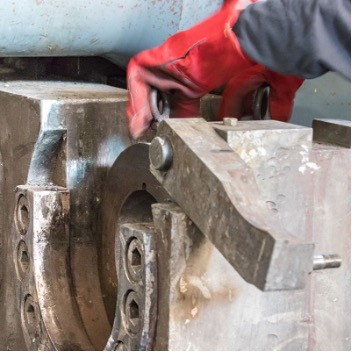
An operator with safety gloves places a profile die inside an aluminum extrusion press

For the engineer, this eliminates the heat-affected zones (HAZ) associated with welding. The fatigue points inherent in mechanical fasteners are also removed. The result? A monolithic component with superior fatigue life and load-bearing capacity.
What a 10,000-ton Press Enables in Practice

The operation of North America’s largest aluminum extrusion press relies on control at scale. Modern 10,000-ton systems integrate advanced automation and closed-loop controls. Such systems maintain consistency from the first billet to the last. This level of precision is essential when producing the largest aluminum profiles for regulated industries.

State-of-the-art press lines prioritize reliability and expand the design envelope, allowing engineers to focus on performance rather than manufacturing constraints.

Specifically, for the aerospace and defense industry, domestic access to this extrusion capacity is critical. Proximity supports program stability and compliance, while also ensuring long-term sustainment. This availability aligns with broader U.S. industrial base priorities emphasizing resilient, onshore manufacturing.

Applying These Capabilities: From Concept to Fabrication

Advanced extrusion profiles create the most value when backed by strong fabrication expertise. Complex profiles often require precision machining, controlled heat treatment, and carefully managed finishing to protect structural integrity. When extrusion and fabrication are integrated, large profiles move efficiently from the press to the final component without unnecessary delays or risk.

An end-to-end approach becomes even more important as part sizes increase and tolerances tighten. Handling is minimized, feedback loops are shortened, and qualification timelines move faster. Furthermore, this integration supports faster qualification for demanding applications.

Bridging the Capability Gap

Only a select number of facilities operate at the scale required to produce the largest aluminum extrusion profiles in North America. Even fewer combine that level of press capacity with the fabrication expertise needed to support aerospace, defense, and heavy industrial applications.

A graphic of the Taber Extrusions with the title, "Something is Coming" and a black cover concealing the state-of-the-art press line

For engineering teams, early validation is critical. Reviewing real-world extrusion examples and feasibility data can help prevent costly redesigns and ensure that complex geometries remain manufacturable at scale.

As profile size and complexity increase, the difference between concept and execution often comes down to access to high-tonnage extrusion and integrated downstream capabilities. With the right extrusion partner, complex structural designs become scalable, manufacturable solutions.

Push past design limits with extrusion power built for scale. Fill out the form below to partner with Taber Extrusions and bring your most demanding structural components to life.
Request A Quote

    CONTACT INFORMATION

    YOUR PROJECT NEEDS

    Please specify extrusion alloy and length below

    If you have design files for extrusion or FSW please upload below

    Excepted file formats: jpg, pdf, png.

    Please specify FSW alloy class, welding type and panel dimensions below.

    Alloy*

    Welding Type*

    Select Billet Size *

    ANY CUI OR FCI DATA IS STRICTLY PROHIBITED FROM BEING UPLOADED DIRECTLY THROUGH THIS FORM. IF YOU NEED TO SHARE ANY SENSITIVE DATA PLEASE CONTACT A TABER SALES TEAM MEMBER AND THEY WILL PROVIDE A SECURE METHOD OF SHARING ANY SENSITIVE INFORMATION.

    17 01, 2026

    Micropress Technology: Revolutionizing Aluminum Extrusions

    2026-01-26T23:39:15+00:00January 17th, 2026|

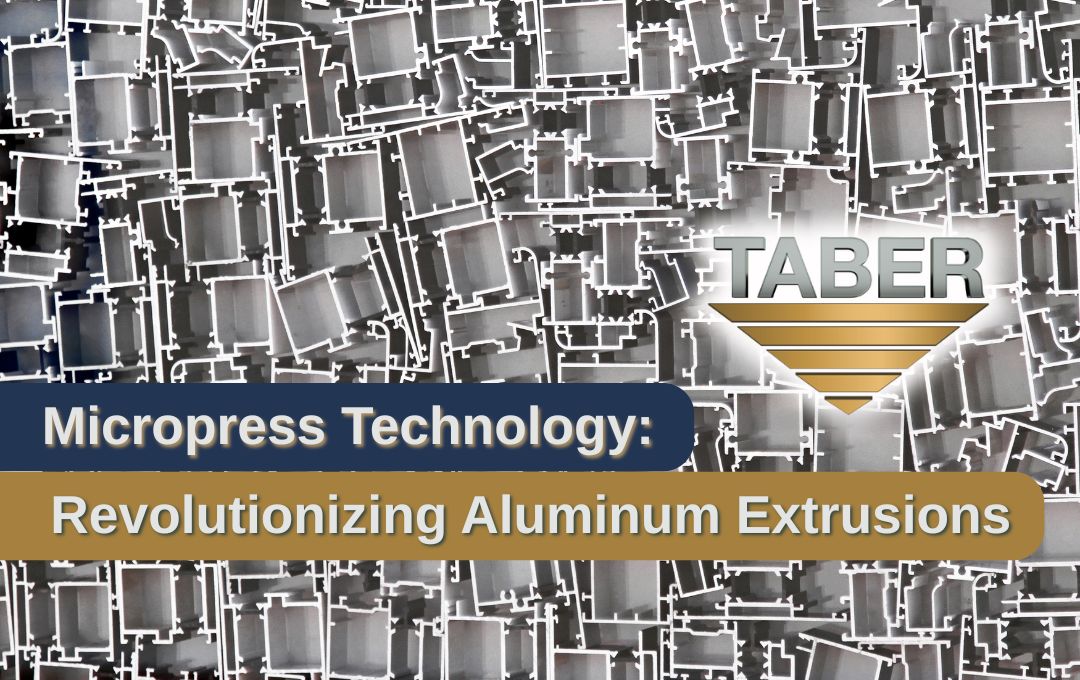
    This graphic features the Taber logo and the title “Micropress Technology: Revolutionizing Aluminum Extrusions” set against a background collage of complex, high-precision aluminum profiles. The visual underscores the variety of intricate shapes achievable with a micropress for aluminum extrusion.

    Key Takeaways:

    • The hidden challenge in modern manufacturing, from medical devices to aerospace electronics, depend on aluminum components so small and precise that traditional presses can’t produce them, quietly limiting innovation.
    • The technology redefining what’s possible is unlocking design freedom at microscopic scales, delivering tolerances, efficiency gains, and sustainability benefits.
    • The precision advantage behind the industry’s next breakthroughs, micro-scale extrusion processes, advanced tooling, and vertically aligned production models, allows manufacturers to achieve consistent, ultra-detailed profiles.

    Micropress for aluminum extrusion is transforming the manufacturing of ultra-precision aluminum profiles and intricate parts, a technology often overlooked in favor of larger presses. By enabling miniature extrusion production runs, micropresses push the boundaries of design and precision for sectors such as medical, aerospace, and high-performance electronics. This technology enhances accuracy, reduces waste, and allows greater design flexibility. Additionally, its integration within a vertically aligned manufacturing model demonstrates how complex industry demands can be met efficiently, shaping the future of precision aluminum extrusion.

    Precision in the Smallest Details: Why Micropress Technology Matters

    In aluminum extrusion, it is recognized that size does not always determine strength. Small press extrusion technology is often used to achieve what the largest presses cannot: dimensional accuracy and surface perfection on a micro scale. Profiles with wall thicknesses as thin as 0.020 inches and tolerances as tight as ±0.001 inches can be produced through the microextrusion process. For ultra-lightweight and compact applications, such as aluminum microtubing for medical catheters or precision electronics, these tolerances are critical to ensuring a perfect fit rather than a near match.

    As a matter of fact, research published in Coatings by MDPI indicates that energy consumption is significantly reduced when aluminum micro-extrusion is optimized with advanced tool coatings. This highlights a broader trend in manufacturing, where precision is paired with sustainable efficiency. By producing smaller profiles with less material waste and fewer reworks, micropresses for aluminum extrusion are aligned with Industry 4.0 and circular manufacturing objectives.

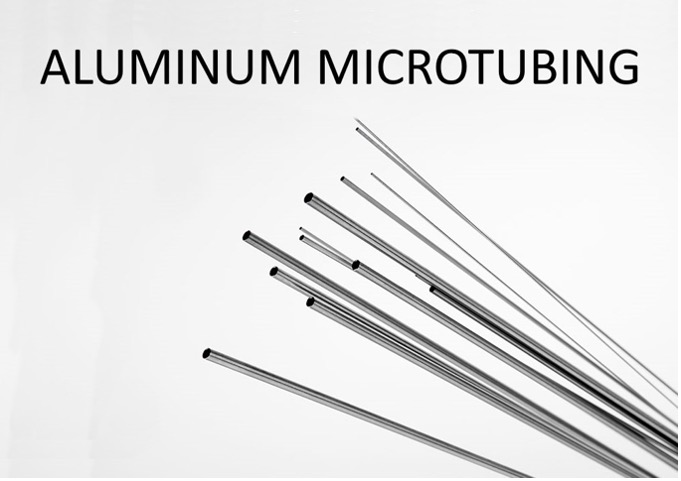
    A collection of fine aluminum microtubes under the heading “ALUMINUM MICROTUBING” showcases a key product made possible by the micropress for the aluminum extrusion process, emphasizing its ability to create components with extremely thin walls.

    Additionally, government-backed innovation projects, such as the National Renewable Energy Laboratory’s (NREL) Shear Assisted Processing and Extrusion (ShAPE), have shown that advanced extrusion techniques improve energy efficiency and metallurgical performance across aluminum alloys. These developments demonstrate that, even at the microscale, the technology contributes to the ongoing evolution toward sustainable, high-efficiency metalworking.

    From Microextrusion Manufacturing to Advanced Applications

    Precision microextrusion is used to enable complex geometries that were once considered unattainable. Through microextrusion manufacturing, intricate channels, ultra-thin fins, and internal cavities can be formed, which are essential for cooling systems, sensors, and lightweight structures. These capabilities are regarded as critical for next-generation products in aerospace, defense, electronics, and medical manufacturing.

    For example, according to this study, microextrusion and microstructure evolution in 6063 aluminum alloy has been shown to enhance microstructural control, yielding higher strength-to-weight ratios and smoother surface finishes. In medical microextrusions, these benefits are translated into safer, more consistent components in devices where precision is life-critical.

    Furthermore, aluminum microtubing is increasingly used in both fluid and electronic systems, driven by industries requiring exacting dimensions and seamless finishes at microscopic scales.

    In every case, micropress for aluminum extrusion is employed alongside large presses, providing complementary precision and nuance. While high tonnage is relied upon to deliver volume, micropresses are used to deliver exacting detail and preci

    Efficiency, Waste Reduction, and Sustainability

    A cleaner, leaner manufacturing cycle is supported by micropress technology. Because excess material is minimized during the microextrusion process, less scrap is produced, and fewer secondary operations are required. It has been shown in studies on microextrusion of aluminum 6063 that forming forces and energy demand are reduced compared to conventional-scale processes (MDPI, 2020).

    This efficiency is also extended beyond the press. Small-press extrusion technology is used to enable rapid prototyping and limited production runs, both of which are considered critical for innovation-driven sectors such as defense and medical device design. Tiny high-precision prototypes can be tested and validated by engineers before full production is scaled, allowing development cycles to be shortened and risk to be reduced.

    Beyond energy and waste reduction, sustainable manufacturing goals are advanced by micropress systems through the conservation of raw materials while exceptional accuracy is achieved. In this way, both lower per-unit costs and smaller environmental footprints are delivered, benefits increasingly recognized by regulators and global markets through sustainability standards and fair production (CBSA aluminum measures).

    Bringing Micropress Expertise to Modern Manufacturing

    While much of the industry looks to massive extrusion capacity as a benchmark of progress, Taber Extrusions takes a balanced view, understanding that innovation also happens in the finer details. As outlined in their Ultra-Precision Extrusions® overview, Taber’s micropress capabilities are engineered to meet the tightest tolerances demanded by advanced OEMs.

    Their microextrusion presses can produce complex, high-performance profiles with repeatable accuracy, while their vertical integration model ensures that every stage remains under strict quality control. For industries where precision and reliability are non-negotiable, Taber’s approach offers both.

    For engineers or procurement specialists looking to explore precision extrusion options, Taber provides design guides and technical resources on aluminum profiles. It’s an excellent starting point for understanding available shapes, sizes, and specifications before beginning a new design. When precision sets the standard, micropress technology stands out as an advanced and intelligent solution, not merely a smaller tool.

    Let’s discuss how microextrusion can advance your next project. Fill out the form below to connect with Taber Extrusions, a partner in aluminum innovation from large presses to the finest micro-scale solutions.

    Request A Quote

      CONTACT INFORMATION

      YOUR PROJECT NEEDS

      Please specify extrusion alloy and length below

      If you have design files for extrusion or FSW please upload below

      Excepted file formats: jpg, pdf, png.

      Please specify FSW alloy class, welding type and panel dimensions below.

      Alloy*

      Welding Type*

      Select Billet Size *

      ANY CUI OR FCI DATA IS STRICTLY PROHIBITED FROM BEING UPLOADED DIRECTLY THROUGH THIS FORM. IF YOU NEED TO SHARE ANY SENSITIVE DATA PLEASE CONTACT A TABER SALES TEAM MEMBER AND THEY WILL PROVIDE A SECURE METHOD OF SHARING ANY SENSITIVE INFORMATION.

      Go to Top