Inside the 10,000-ton Press Driving the Future of Aluminum Extrusion Profiles
Key Takeaways:
- Engineering teams often face design limitations when sourcing large aluminum extrusion profiles, forcing compromises like welded assemblies, added weight, and increased failure points.
- A 10,000-ton aluminum extrusion press removes these constraints, enabling larger, more complex, and monolithic profiles with tighter tolerances and improved structural performance
- By combining high-tonnage extrusion with integrated fabrication, manufacturers can reduce assembly, accelerate production timelines, and deliver consistent, high-performance components for aerospace, defense, and heavy industry.
Aluminum extrusion profiles are redefining what is possible in modern aerospace, defense, and heavy industry manufacturing. Demand for integrated, monolithic structures now exceeds traditional fabrication limits. As a result, extrusion capability and available press force have become critical constraints. High-performance profiles require immense power and complex tooling; however, a 10,000-ton direct press changes the equation. Operating at unprecedented scale, it enables wider cross-sections, tighter tolerances, and the precise forming of hard alloys once considered impractical. Moreover, higher tonnage improves grain structure reliability, bridging the gap between ambitious design and manufacturable reality.
Why Press Size Matters for Aluminum Extrusion Profiles
Aluminum extrusion relies on controlled deformation. Billet temperature, alloy chemistry, die design, and press force determine final profile quality. When press capacity is limited, compromises such as thicker walls, segmented assemblies, secondary weldments, and longer lead times are often introduced.
A 10,000-ton press removes many of these constraints. Larger cross-sections can be produced, and tighter dimensional control is maintained. In addition, metal flow is kept uniform across wide or complex profiles. This capability is essential in aerospace manufacturing, where long structural members reduce fasteners and failure points. Likewise, in defense manufacturing, strength-to-weight ratios and repeatability must be achieved without variation.
Other advantages include more refined grain structure due to the higher force, as well as improved mechanical consistency. For heavy industry applications such as cranes, transportation infrastructure, and energy systems, fewer joints and simpler assemblies are realized. Therefore, lifecycle performance is enhanced. Press manufacturers such as SMS group design these systems for reliability and automation at extreme tonnage, so consistent production at scale can be sustained. These advantages aren’t just theoretical; they directly expand what engineers can design and manufacture.
Large Aluminum Extrusion Profiles: What Becomes Possible at 10,000 Tons
At 10,000 tons of force, aluminum extrusion profiles move beyond traditional size and complexity limits. Larger cross-sections, wider circumscribing circles, and tighter tolerances become achievable in a single pass, even with high-strength alloys like 2024 and 7075. This enables engineers to replace multi-part assemblies with monolithic components, reducing welds, minimizing failure points, and improving overall structural performance in demanding aerospace, defense, and heavy industrial applications.
The Physics of Force: Hard Alloys and Complex Geometries
Now, the primary challenge in high-performance extrusion is flow stress. Soft alloys like 6063 flow easily through dies. However, hard alloys used in aerospace manufacturing (such as 2024 and 7075) exhibit significant resistance. These materials exhibit high flow stress values, requiring high specific pressure to achieve plastic deformation without tearing or surface defects.
A 10,000-ton press provides the necessary specific pressure to push these “stiff” alloys through complex dies at reasonable speeds. This capability is distinct from simple tonnage since it relates to the container size and the reduction ratio. With a 10,000-ton force applied to a standard 16-inch billet, the specific pressure on the dummy block increases dramatically, optimizing the physics of the extrusion cycle.
This high-pressure environment yields two specific engineering benefits:
- Refined grain structure: Higher pressure promotes complete recrystallization during extrusion. This creates a uniform grain structure from the front to the back of the profile. In defense manufacturing, this consistency is critical for ballistic and structural integrity.
- Wider circle sizes: The combination of high force and large billet containers enables profiles with circles up to 20 inches or wider. This enables designers to create single-piece bulkheads, floor beams, or vehicle chassis components that previously required welding multiple smaller extrusions together.
For the engineer, this eliminates the heat-affected zones (HAZ) associated with welding. The fatigue points inherent in mechanical fasteners are also removed. The result? A monolithic component with superior fatigue life and load-bearing capacity.
What a 10,000-ton Press Enables in Practice
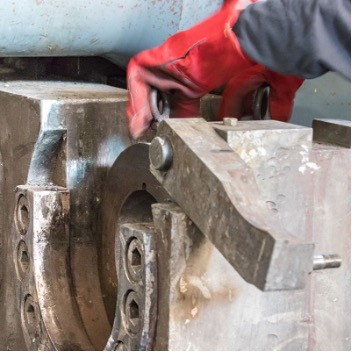
The operation of North America’s largest aluminum extrusion press relies on control at scale. Modern 10,000-ton systems integrate advanced automation and closed-loop controls. Such systems maintain consistency from the first billet to the last. This level of precision is essential when producing the largest aluminum profiles for regulated industries.
State-of-the-art press lines prioritize reliability and expand the design envelope, allowing engineers to focus on performance rather than manufacturing constraints.
Specifically, for the aerospace and defense industry, domestic access to this extrusion capacity is critical. Proximity supports program stability and compliance, while also ensuring long-term sustainment. This availability aligns with broader U.S. industrial base priorities emphasizing resilient, onshore manufacturing.
Applying These Capabilities: From Concept to Fabrication
Advanced extrusion profiles create the most value when backed by strong fabrication expertise. Complex profiles often require precision machining, controlled heat treatment, and carefully managed finishing to protect structural integrity. When extrusion and fabrication are integrated, large profiles move efficiently from the press to the final component without unnecessary delays or risk.
An end-to-end approach becomes even more important as part sizes increase and tolerances tighten. Handling is minimized, feedback loops are shortened, and qualification timelines move faster. Furthermore, this integration supports faster qualification for demanding applications.
Bridging the Capability Gap
Only a select number of facilities operate at the scale required to produce the largest aluminum extrusion profiles in North America. Even fewer combine that level of press capacity with the fabrication expertise needed to support aerospace, defense, and heavy industrial applications.

For engineering teams, early validation is critical. Reviewing real-world extrusion examples and feasibility data can help prevent costly redesigns and ensure that complex geometries remain manufacturable at scale.
As profile size and complexity increase, the difference between concept and execution often comes down to access to high-tonnage extrusion and integrated downstream capabilities. With the right extrusion partner, complex structural designs become scalable, manufacturable solutions.
Push past design limits with extrusion power built for scale. Fill out the form below to partner with Taber Extrusions and bring your most demanding structural components to life.