3 04, 2026

Inside the 10,000-ton Press Driving the Future of Aluminum Extrusion Profiles
2026-04-03T03:29:36+00:00April 3rd, 2026|

Digital circuitry background with icons of an airplane, naval ship, and excavator representing aerospace, marine, and heavy industrial aluminum extrusion applications.

Key Takeaways:

  • Engineering teams often face design limitations when sourcing large aluminum extrusion profiles, forcing compromises like welded assemblies, added weight, and increased failure points.
  • A 10,000-ton aluminum extrusion press removes these constraints, enabling larger, more complex, and monolithic profiles with tighter tolerances and improved structural performance
  • By combining high-tonnage extrusion with integrated fabrication, manufacturers can reduce assembly, accelerate production timelines, and deliver consistent, high-performance components for aerospace, defense, and heavy industry.

Aluminum extrusion profiles are redefining what is possible in modern aerospace, defense, and heavy industry manufacturing. Demand for integrated, monolithic structures now exceeds traditional fabrication limits. As a result, extrusion capability and available press force have become critical constraints. High-performance profiles require immense power and complex tooling; however, a 10,000-ton direct press changes the equation. Operating at unprecedented scale, it enables wider cross-sections, tighter tolerances, and the precise forming of hard alloys once considered impractical. Moreover, higher tonnage improves grain structure reliability, bridging the gap between ambitious design and manufacturable reality.

Why Press Size Matters for Aluminum Extrusion Profiles

Aluminum extrusion relies on controlled deformation. Billet temperature, alloy chemistry, die design, and press force determine final profile quality. When press capacity is limited, compromises such as thicker walls, segmented assemblies, secondary weldments, and longer lead times are often introduced.

A 10,000-ton press removes many of these constraints. Larger cross-sections can be produced, and tighter dimensional control is maintained. In addition, metal flow is kept uniform across wide or complex profiles. This capability is essential in aerospace manufacturing, where long structural members reduce fasteners and failure points. Likewise, in defense manufacturing, strength-to-weight ratios and repeatability must be achieved without variation.

Other advantages include more refined grain structure due to the higher force, as well as improved mechanical consistency. For heavy industry applications such as cranes, transportation infrastructure, and energy systems, fewer joints and simpler assemblies are realized. Therefore, lifecycle performance is enhanced. Press manufacturers such as SMS group design these systems for reliability and automation at extreme tonnage, so consistent production at scale can be sustained. These advantages aren’t just theoretical; they directly expand what engineers can design and manufacture.

Large Aluminum Extrusion Profiles: What Becomes Possible at 10,000 Tons

At 10,000 tons of force, aluminum extrusion profiles move beyond traditional size and complexity limits. Larger cross-sections, wider circumscribing circles, and tighter tolerances become achievable in a single pass, even with high-strength alloys like 2024 and 7075. This enables engineers to replace multi-part assemblies with monolithic components, reducing welds, minimizing failure points, and improving overall structural performance in demanding aerospace, defense, and heavy industrial applications.

The Physics of Force: Hard Alloys and Complex Geometries

Now, the primary challenge in high-performance extrusion is flow stress. Soft alloys like 6063 flow easily through dies. However, hard alloys used in aerospace manufacturing (such as 2024 and 7075) exhibit significant resistance. These materials exhibit high flow stress values, requiring high specific pressure to achieve plastic deformation without tearing or surface defects.

A 10,000-ton press provides the necessary specific pressure to push these “stiff” alloys through complex dies at reasonable speeds. This capability is distinct from simple tonnage since it relates to the container size and the reduction ratio. With a 10,000-ton force applied to a standard 16-inch billet, the specific pressure on the dummy block increases dramatically, optimizing the physics of the extrusion cycle.

This high-pressure environment yields two specific engineering benefits:

  1. Refined grain structure: Higher pressure promotes complete recrystallization during extrusion. This creates a uniform grain structure from the front to the back of the profile. In defense manufacturing, this consistency is critical for ballistic and structural integrity.
  2. Wider circle sizes: The combination of high force and large billet containers enables profiles with circles up to 20 inches or wider. This enables designers to create single-piece bulkheads, floor beams, or vehicle chassis components that previously required welding multiple smaller extrusions together.
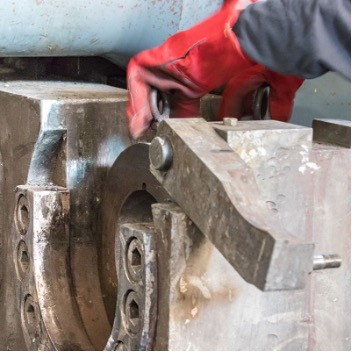
An operator with safety gloves places a profile die inside an aluminum extrusion press

For the engineer, this eliminates the heat-affected zones (HAZ) associated with welding. The fatigue points inherent in mechanical fasteners are also removed. The result? A monolithic component with superior fatigue life and load-bearing capacity.
What a 10,000-ton Press Enables in Practice

The operation of North America’s largest aluminum extrusion press relies on control at scale. Modern 10,000-ton systems integrate advanced automation and closed-loop controls. Such systems maintain consistency from the first billet to the last. This level of precision is essential when producing the largest aluminum profiles for regulated industries.

State-of-the-art press lines prioritize reliability and expand the design envelope, allowing engineers to focus on performance rather than manufacturing constraints.

Specifically, for the aerospace and defense industry, domestic access to this extrusion capacity is critical. Proximity supports program stability and compliance, while also ensuring long-term sustainment. This availability aligns with broader U.S. industrial base priorities emphasizing resilient, onshore manufacturing.

Applying These Capabilities: From Concept to Fabrication

Advanced extrusion profiles create the most value when backed by strong fabrication expertise. Complex profiles often require precision machining, controlled heat treatment, and carefully managed finishing to protect structural integrity. When extrusion and fabrication are integrated, large profiles move efficiently from the press to the final component without unnecessary delays or risk.

An end-to-end approach becomes even more important as part sizes increase and tolerances tighten. Handling is minimized, feedback loops are shortened, and qualification timelines move faster. Furthermore, this integration supports faster qualification for demanding applications.

Bridging the Capability Gap

Only a select number of facilities operate at the scale required to produce the largest aluminum extrusion profiles in North America. Even fewer combine that level of press capacity with the fabrication expertise needed to support aerospace, defense, and heavy industrial applications.

A graphic of the Taber Extrusions with the title, "Something is Coming" and a black cover concealing the state-of-the-art press line

For engineering teams, early validation is critical. Reviewing real-world extrusion examples and feasibility data can help prevent costly redesigns and ensure that complex geometries remain manufacturable at scale.

As profile size and complexity increase, the difference between concept and execution often comes down to access to high-tonnage extrusion and integrated downstream capabilities. With the right extrusion partner, complex structural designs become scalable, manufacturable solutions.

Push past design limits with extrusion power built for scale. Fill out the form below to partner with Taber Extrusions and bring your most demanding structural components to life.

Request A Quote

    CONTACT INFORMATION

    YOUR PROJECT NEEDS

    Please specify extrusion alloy and length below

    If you have design files for extrusion or FSW please upload below

    Excepted file formats: jpg, pdf, png.

    Please specify FSW alloy class, welding type and panel dimensions below.

    Alloy*

    Welding Type*

    Select Billet Size *

    ANY CUI OR FCI DATA IS STRICTLY PROHIBITED FROM BEING UPLOADED DIRECTLY THROUGH THIS FORM. IF YOU NEED TO SHARE ANY SENSITIVE DATA PLEASE CONTACT A TABER SALES TEAM MEMBER AND THEY WILL PROVIDE A SECURE METHOD OF SHARING ANY SENSITIVE INFORMATION.

    16 03, 2026

    Ultra-Precision Extrusions for Aerospace Equals Lightweight Precision at Scale

    2026-03-17T15:49:34+00:00March 16th, 2026|

    Close-up of a plane wing in the sky with aluminum extrusion profiles aligned to a ruler, highlighting ultra-precision, scalable, lightweight aerospace manufacturing.

    Key Takeaways:

    • Interface control is a critical challenge in aerospace design. Weight must be reduced without sacrificing structural integrity, and uncontrolled interfaces often lead to fit issues, rework, and schedule delays.
    • Ultra-precision extrusions consolidate complexity into a single profile. Tight tolerances, thin walls, and integrated features reduce part count, minimize interfaces, and improve repeatability at scale.
    • Find ultra-precision capability with production-ready consistency. A vertically integrated process, tight tolerance control, and aerospace alloy expertise enable fully qualified components, not just raw profiles.

    Ultra precision extrusions are increasingly specified for aerospace applications as a definitive solution to the ongoing challenge of interface control. In this sector, mass reduction is continually required, yet structural integrity cannot be compromised. As a result, greater design emphasis is being placed on aerospace aluminum extrusion for components that must remain lightweight, repeatable, and production-ready. Discover how Ultra-Precision Extrusions® differ from conventional processes and where they are applied across structural, system, and electronic use cases. Additionally, critical manufacturing specifications are reviewed to help minimize part count, reduce interfaces, and prevent late-stage production issues.

    Defining the Difference: Ultra-Precision Extrusions® in Aerospace

    This manufacturing category occupies a distinct niche, as the process is engineered to exceed standard “near-net” definitions. Rather than relying on multiple machined features and complex assemblies, critical geometry is maintained within a single, continuous profile over its full length. Consequently, when tolerance failures occur in flight hardware production, the cost extends well beyond immediate scrap. Downstream effects are often triggered, including fit issues, rework, nonconformances, and schedule disruption.

    Within high-performance aerospace programs, strict “key characteristics” are therefore prioritized to govern assembly function, including datum surfaces, mating grooves, thin-wall channels, and alignment features. To support these requirements, Ultra-Precision Extrusions® are produced in profiles fitting within a 3-inch circle, with minimum wall thicknesses of 0.010 inches and standard tolerances of ±0.003 inches. Moreover, key characteristic tolerances as tight as ±0.001 inches and surface finishes of 32 RMS or better can be achieved. These capabilities define a class of aerospace components that demand high repeatability without reliance on extensive post-machining. Critical features must be inspectable using intended metrology (CMM access, optical, probes) without fixturing that distorts thin walls. Neglecting this step often results in parts that are manufacturable but difficult to measure accurately at production rates.

    To leverage these capabilities, engineers must address two primary realities:

    • Design for verification: Critical features must be inspectable using intended metrology (CMM access, optical, probes) without fixturing that distorts thin walls. Neglecting this step often results in parts that are manufacturable but difficult to measure accurately at production rates.
    • Functional subsystem integration: This approach aligns lightweight aerospace materials with manufacturing efficiency. Thin-wall channels function as structural ribs, cable guides, fluid passages, or thermal paths within a single profile. Correct implementation reduces part count and minimizes interface risks.

    For additional background on how precision extrusion programs are framed, review current standards for Ultra Precision aluminum extrusions and discussions on custom aluminum extrusions in precision manufacturing.

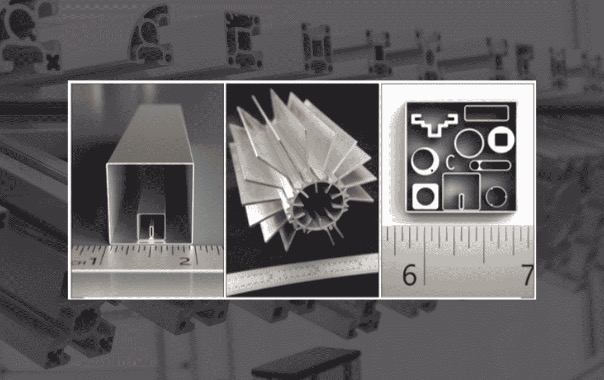
    Three aluminum extrusion profiles shown with rulers for scale, highlighting complex hollow, finned, and multi-shape designs achievable with ultra-precision extrusions.

    Where Ultra-Precision Extrusions® Deliver Leverage in Aerospace: Structures, Systems, and Electronics

    • Structural components (aircraft and space)

    Aerospace aluminum extrusion technologies are widely applied in programs requiring lightweight, stiff geometries with stable interfaces maintained over long lengths. Components such as rails, frames, stiffeners, brackets, and sub-structure elements are commonly produced to align precisely with fasteners, skins, or composite interfaces. Beyond initial fit, fatigue and damage tolerance requirements place added pressure on geometry control and repeatability. Compliance must be demonstrated over the component’s service life, not just at first article. Accordingly, guidance such as FAA AC 23-13A underscores how structural evaluation is directly linked to long-term durability expectations.

    • Specialized system components (missiles, UAVs, aircraft subsystems)

    In this category, extrusion processes are often leveraged to mitigate packaging and integration risk. Many aerospace “systems” parts present dense design challenges, including actuator housings, sensor mounts, guides, retainers, frames, and protective channels that must endure vibration and thermal cycling while maintaining tight alignment. Through ultra-precision profiles, multiple machined pieces and brackets are consolidated into a single geometry. As a result, fastener counts are reduced and variability in assembly torque is minimized. With rising demand across defense programs such as hypersonic weapons and space systems, schedule pressure and domestic sourcing constraints further elevate the value of a scalable, consolidated process.

    • Electronics and thermal applications (spacecraft and avionics)

    Electronics packaging introduces additional requirements for dimensional control and thermal management. Precision extrusions are therefore selected for housings, rails, and heat-sink geometries where channel consistency directly affects airflow, conduction paths, and assembly fit. To support these designs, material properties must be defensible and well-documented. References such as NIST material data provide a credible foundation for evaluating the thermal and physical characteristics of common alloys, including 6061-T6, which is widely used in structural and thermal aerospace applications.


    Across all three use cases, corrosion control remains a practical requirement for aluminum systems operating in demanding service environments. Guidance such as FAA AC 43-4B informs how operators and MRO organizations approach corrosion prevention. In turn, these expectations shape coating selection, surface treatments, and finishing strategies during the design phase.

    Taber Extrusions: Ultra-Precision Capability at Production Scale

    When an aerospace engineering team specifies complex micro-geometries, the critical inquiry is rarely regarding simple feasibility. Rather, the focus is on whether the supplier can consistently maintain key characteristics, validate compliance, and sustain delivery schedules during production ramp-up.

    Taber Extrusions’ Ultra-Precision Extrusions® capability is purpose-built for micro-extrusion programs requiring tight tolerances and thin-wall geometries. To support early design planning, concrete capability markers, such as minimum wall thickness and key characteristic tolerances, are published within the company’s corporate brochure. In addition, comprehensive alloy family support across the 2xxx, 5xxx, 6xxx, and 7xxx series is outlined. A vertically integrated manufacturing model is also maintained, extending beyond extrusion into fabrication and machining. As a result, fully qualified components can be delivered when program requirements extend beyond a raw profile.

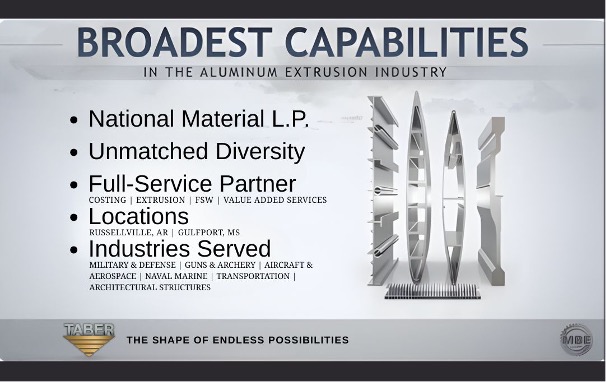
    A promotional slide features the NMLP logo and highlights aluminum extrusion capabilities across multiple industries, including aerospace and defense. The layout emphasizes ultra-precision extrusions as part of a full-service offering that includes casting, friction stir welding, and value-added services.

    For evaluators assessing potential fit, Taber provides detailed context on the industries it serves, along with specific resources for ultra precision aluminum extrusions and custom extrusion processes.

    Download the capabilities overview to use as a Request for Quote (RFQ) or Design for Manufacturing (DFM) checklist: Taber Extrusions corporate brochure (PDF). If a program requires high-performance aerospace parts where weight optimization, interface control, and repeatability are mandatory, early engagement is critical.

    Review geometry, key characteristics, and inspection strategies before design freeze to mitigate downstream costs. Fill out the form below to contact Taber today!

    Request A Quote

      CONTACT INFORMATION

      YOUR PROJECT NEEDS

      Please specify extrusion alloy and length below

      If you have design files for extrusion or FSW please upload below

      Excepted file formats: jpg, pdf, png.

      Please specify FSW alloy class, welding type and panel dimensions below.

      Alloy*

      Welding Type*

      Select Billet Size *

      ANY CUI OR FCI DATA IS STRICTLY PROHIBITED FROM BEING UPLOADED DIRECTLY THROUGH THIS FORM. IF YOU NEED TO SHARE ANY SENSITIVE DATA PLEASE CONTACT A TABER SALES TEAM MEMBER AND THEY WILL PROVIDE A SECURE METHOD OF SHARING ANY SENSITIVE INFORMATION.

      Go to Top